US to curb China's access to AI chips as Trump heads to Asia
The Trump administration issued a new rule on Monday restricting China's access to advanced AI chips through overseas data centers. This measure requires companies in Singapore, Thailand, Malaysia, Indonesia, and Brazil to apply for US export licenses, coinciding with President Donald Trump's trip to China to meet President Xi Jinping.
The new US rule targets the use of overseas data centers by Chinese companies to access advanced AI chips for training artificial intelligence models. The Commerce Department stated the measure is designed to ensure existing restrictions on sensitive American technology cannot be circumvented through remote computing arrangements involving data centers in third countries.
Companies operating in Singapore, Thailand, Malaysia, Indonesia, and Brazil are now required to obtain US export licenses for advanced chips. The administration cited these five countries as presenting a higher-than-normal risk of illegally diverting the chips to China.
This action was announced as President Donald Trump began a trip to China, with a meeting scheduled for Thursday with President Xi Jinping in Shenzhen during the APEC summit. The Commerce Secretary is accompanying Trump, facing pressure after reports that the agency had previously failed to curb Chinese access to overseas data centers and allowed restricted Nvidia chips to flow.
The new restriction formally rescinds a Biden-era global licensing rule that limited global access to AI chips. The Commerce Department had indicated in early 2025 that it would rescind and replace this rule but did not take action until Monday, which reportedly allowed billions of dollars' worth of restricted Nvidia chips to reach data centers used by Chinese AI companies.
Systems used by online retailers and social media companies are explicitly exempted from the new restrictions. The Commerce Department stated that these specific uses do not pose the same national security concerns addressed by the broader rule. The Treasury Department and National Security Council were identified as the entities that wrote the rule and directed its release.
Share this article
Related reading
6 stories
Superhuman pushes its Go assistant everywhere
Stuck in the Pile: Why India's answer sheets need an AI rescue

Anthropic's historic debut to put AI's promise and peril on Wall St trial
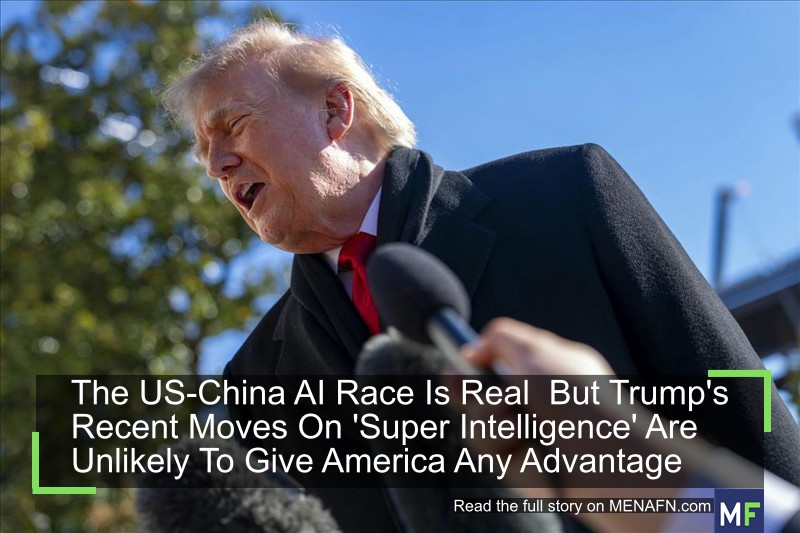
The US-China AI Race Is Real But Trump's Recent Moves On 'Super Intelligence' Are Unlikely To Give America Any Advantage #US-China #Race #Real #Trump's #Recent #Moves #'Super #Intelligence' #Unlikely #Give #America #Advantage #USA #Russia #Biden #Ukraine #War #Palestine #Gaza #Israel #

BlackLine partners with OpenAI to bring AI agents to finance teams