Singapore in damage control after Nvidia scandal exposes China loophole
Singapore's reputation as a trusted business hub faces scrutiny following allegations that Chinese companies exploited it to access high-end AI chips despite US export restrictions. The widening scandal, which spotlighted the city-state's role in the global semiconductor supply chain, led the United States on Monday to introduce new measures broadening its export controls.
Singapore is working to safeguard its standing as a reliable business hub amidst allegations that Chinese entities have used the city-state to circumvent US export restrictions on advanced AI chips. This issue gained prominence following reports of an affair between Jensen Huang, until recently head of US chip titan Nvidia, and Alice Huang, a suspected Chinese spy and former executive at Singapore-based Megaspeed International. Washington is investigating Megaspeed for alleged transfers of Nvidia chips to China.
On Monday, the United States moved to close a loophole in its controls, which it states protect national security. The new US rules aim to crack down on illicit chip smuggling and address the practice of Chinese companies renting computing power from data centers in third countries, often in Southeast Asia, that are equipped with advanced Nvidia chips. Nvidia controls an estimated 90 percent of the market for chips used to train and run AI models.
These measures now require data centers worldwide to hold a US license to provide a large volume of computing power from advanced chips to companies headquartered in China or other places under US arms embargoes. Additionally, a US license will be needed to ship advanced chips directly to Singapore, Malaysia, Thailand, Indonesia, and Brazil. The US Commerce Department identified these nations as presenting a "higher-than-normal risk of diversion" for sensitive components.
Singapore's government stated it is carefully studying these new measures and does not "condone companies using their association with Singapore to circumvent or violate the laws of other countries in their international business activities, including export controls." Singapore is also conducting its own probe into Megaspeed International, which reportedly traded upwards of $4 billion worth of Nvidia chips over two years. A financial trail suggests Megaspeed's business may have been boosted by a connection to Chinese tech giant Alibaba.
Chong Ja Ian, a political scientist at the National University of Singapore, suggested that Singapore must strengthen regulatory oversight beyond simply dealing with individual cases to avoid perceptions of "systemic issues." Rajiv Biswas, chief of the risk consultancy Asia-Pacific Economics in Singapore, noted that the primary responsibility for such export controls should rest with the government issuing them, rather than outsourcing enforcement to other jurisdictions. Singapore has attracted more than $23 billion in investments between 2022-2025, positioning itself as a "critical node" in the global semiconductor supply chain.
Share this article
Related reading
6 stories
What to expect from US-China AI safety talks
Our prior coverage explored the complex US-China AI safety talks, a key backdrop to these export restrictions.

Superhuman pushes its Go assistant everywhere
Stuck in the Pile: Why India's answer sheets need an AI rescue

Anthropic's historic debut to put AI's promise and peril on Wall St trial
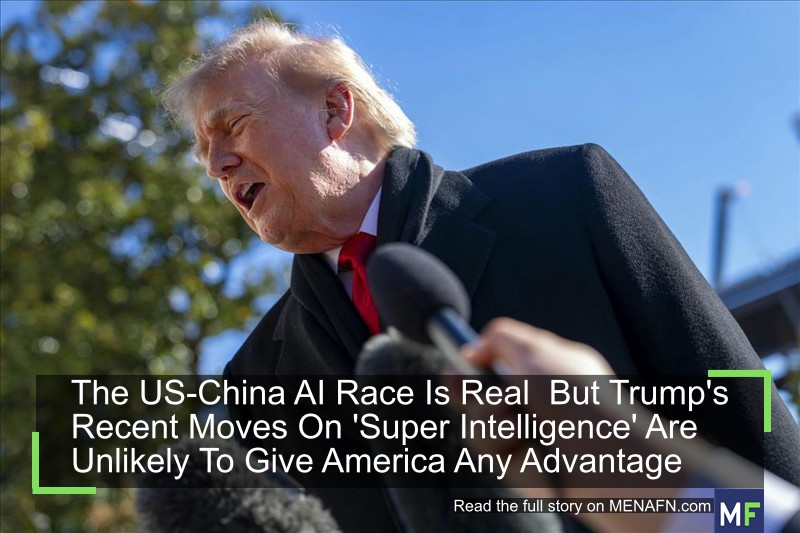
The US-China AI Race Is Real But Trump's Recent Moves On 'Super Intelligence' Are Unlikely To Give America Any Advantage #US-China #Race #Real #Trump's #Recent #Moves #'Super #Intelligence' #Unlikely #Give #America #Advantage #USA #Russia #Biden #Ukraine #War #Palestine #Gaza #Israel #