
OpenAI says AI solved one of math's hardest problems in days
OpenAI announced that one of its unreleased AI models has solved the Navier-Stokes problem, a mathematical puzzle concerning fluid dynamics that has eluded mathematicians for generations. The company claims its AI cracked the problem in days, utilizing millions of dollars in computing power and 10,000 AI agents. This problem is one of the seven Millennium Prize Problems, each carrying a $1 million reward, though OpenAI states it will not claim the prize money. The solution must undergo a rigorous, multi-year peer-review process before official confirmation by the Clay Mathematics Institute. The announcement sparked a dispute over credit with rival researchers from Anthropic and New York University, who claim OpenAI pursued a similar approach after learning of their work.
OpenAI's claim to have solved the Navier-Stokes problem, one of the Millennium Prize Problems, highlights the accelerating pace of AI in high-level mathematics. While the $1 million prize is not the focus, the achievement suggests AI models can tackle complex, long-unsolved scientific challenges. This capability could significantly impact engineering, weather forecasting, and medical research across Asia, where nations like China, South Korea, and Singapore are heavily investing in AI for scientific discovery and industrial applications. The speed of the breakthrough, achieved in days with millions in computing costs, underscores the resource intensity of frontier AI research. The dispute over credit with Anthropic researchers also points to the intense competition and rapid development cycles within the global AI sector. This will likely drive further investment in AI compute infrastructure across Asia, as companies and governments seek to replicate such breakthroughs. The long peer-review process for the solution, potentially two years, will be a critical test of AI-generated mathematical proofs. The debate over whether machine-generated answers truly constitute human understanding will continue to shape how these solutions are integrated into scientific practice.
Related reading
6 stories
As China embraces AI, only 24% of US pharma execs bet on it for drug-making
AI's rapid advance in complex problem-solving contrasts with its slower adoption in some sectors, like drug-making.
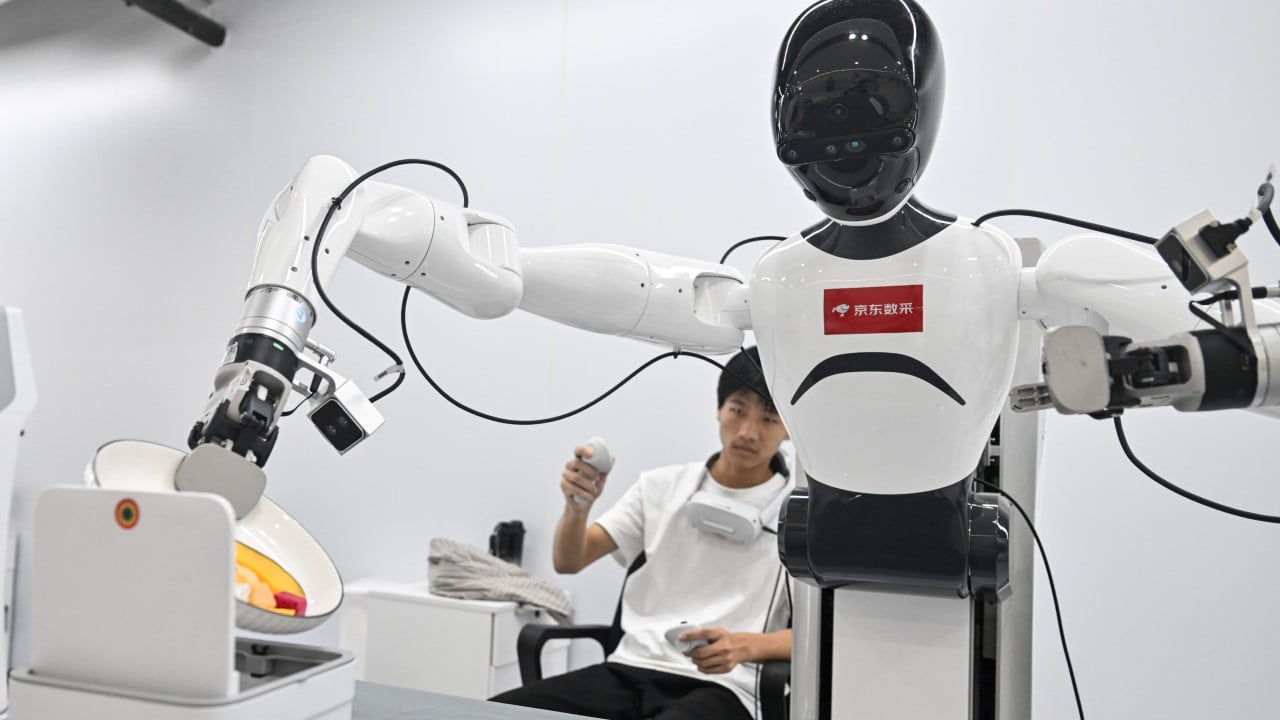
Amid China’s AI shift, JD.com bets on 3 million robots to automate logistics
The article highlights AI's impact on industrial applications, mirroring JD.com's massive AI investment in logistics.

People’s Daily rejects US claims of malicious AI distillation, warns of countermeasures

Databricks to Invest Over US$350 Million in Singapore, Double Its Workforce

Personetics Launches AI Banking Console for Relationship Managers
