China’s hypercompetition goes global as Beijing frets over backlash
Chinese companies, particularly in the EV and AI component sectors, are intensifying global expansion due to domestic hypercompetition and overcapacity. Autolink, a Wuxi-based AI component producer for EVs, has invested RMB 1.6 billion (USD 237.5 million) but remains unprofitable amidst fierce competition. This aggressive push abroad has led to a record 22.7% of total revenue from overseas for 3,775 publicly traded Chinese companies last year, totaling RMB 12.38 trillion (USD 1.8 trillion). This strategy, however, is causing global trade friction and accusations of exporting deflation, with countries like Germany and Brazil raising concerns about job displacement and unfair competition.
China's "involution" a term for cutthroat domestic price competition and diminishing profit margins, is now a global phenomenon, particularly in the EV and AI component sectors. Chinese companies are pushing aggressively into international markets to offset anemic domestic demand, with overseas revenue for 3,775 publicly traded Chinese firms reaching a record 22.7% of total revenue last year. This export drive, however, is leading to accusations of dumping and trade friction, as seen with Germany's complaints and Brazil's increased tariffs on EVs. The core issue for Asian tech professionals is the sustainability of this model. While companies like Geely report higher profits on exported cars (RMB 12,000–15,000 per car) compared to domestic sales (less than RMB 3,000 for an NEV), overall profit margins for Chinese automakers dropped to 3.8% in the first half of 2026 from 8% in 2017. This suggests that even global dominance in market share is not translating into robust profitability. The thing to watch is how Beijing's "anti-involution" campaign, which includes warnings against exporting price wars, will balance with local governments' continued support for tech champions and their reluctance to shed idle capacity.
Related reading
6 stories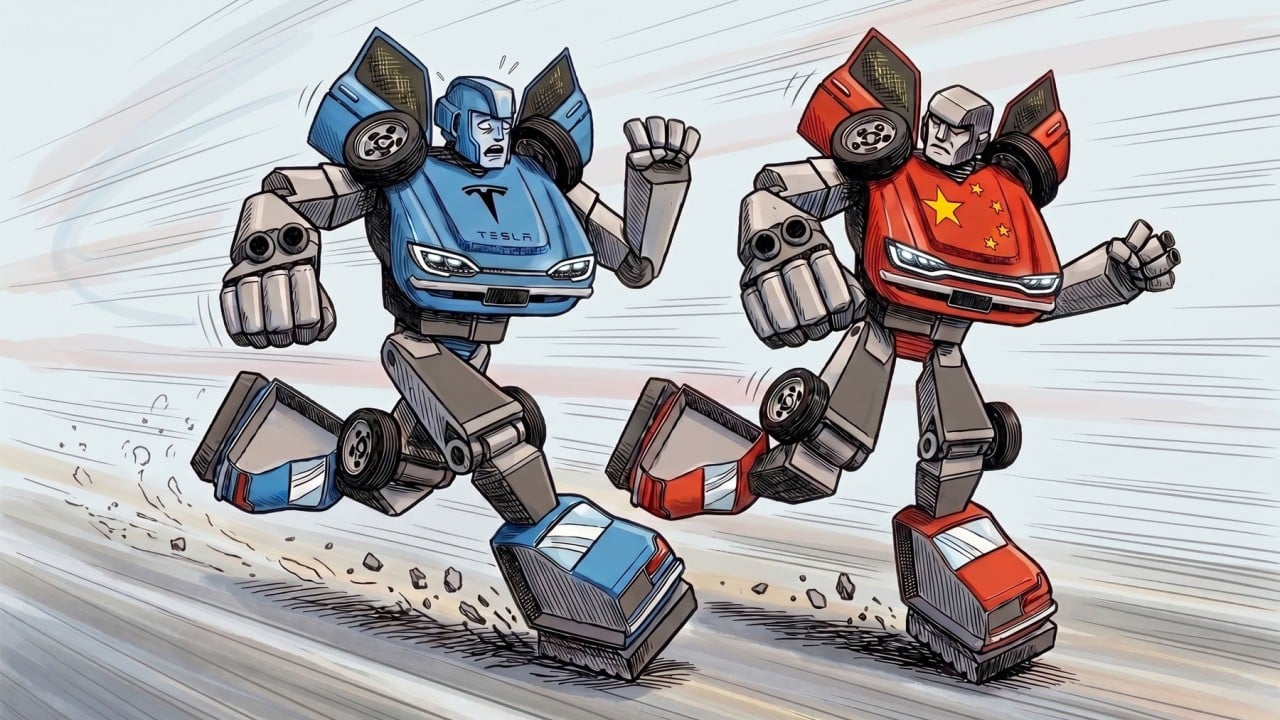
China’s ‘Tesla imitators’ have a new mission: build affordable humanoid robots for consumers
China's hypercompetition in EVs is now extending to affordable humanoid robots, a new frontier for involution.

Geely E2 electric hatchback arrived at dealers in Belgium ahead of launch
Geely, mentioned in the article, is one of the Chinese EV makers pushing into European markets.
People’s Daily rejects US claims of malicious AI distillation, warns of countermeasures

Databricks to Invest Over US$350 Million in Singapore, Double Its Workforce

ByteDance’s AI-enhanced short-drama app eclipses China’s Netflix rivals combined