
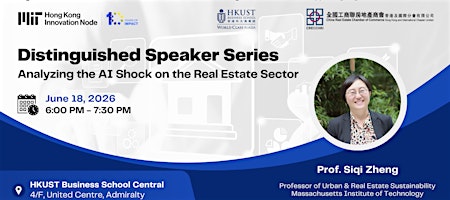
MIT Seminar: Analyzing the AI Shock on the Real Estate Sector
An MIT seminar led by Professor Siqi Zheng exploring how AI is reshaping real estate through digital infrastructure expansion and the rise of data centers.
MIT Seminar: Analyzing the AI Shock on the Real Estate Sector
An MIT seminar led by Professor Siqi Zheng exploring how AI is reshaping real estate through digital infrastructure expansion and the rise of data centers.
About the Speaker Siqi Zheng is a prominent professor of Urban and Real Estate Sustainability at MIT, directing the MIT Center for Real Estate and the Sustainable Urbanization Lab, focusing on environmental economics and green city development. She recently established the MIT Asia Real Estate Initiative to advance sustainable real estate development, management, and investment across Asia's rapidly urbanizing regions. Prof. Zheng is currently the President of the American Real Estate and Urban Economics Association (AREUEA) and was the former President of the Asian Real Estate Society (2018-2019). A recognized expert in her field, Prof. Zheng is the Co-Editor of the Journal of Regional Science and formerly the co-editor of Environmental and Resource Economics, where she is currently a member of the Scientific Advisory Board. She is on the editorial board of Real Estate Economics, Journal of Housing Economics, Journal of Real Estate Finance and Economics, and the Journal of Real Estate Research. About the Topic Analyzing the AI Shock on the Real Estate Sector The Physical Footprint of Digital Intelligence—AI is reshaping the built environment through a dual shock: dampening demand for traditional real estate while fuelling an explosive expansion in digital infrastructure. Led by Professor Siqi Zheng, head of MIT Center for Real Estate, this seminar delivers analysis and strategic insights into: • The “Digital Gravity” concept and contrasting Hyperscale vs. Colocation operating models; • Rapid rise of data centers as a high-conviction real asset category; • Challenges in power availability, sustainability, and social impacts; • Unlocking energy efficiency with retrofitting of existing buildings; and • Location strategies—balancing power economics against network latency that are reconfiguring global real asset distributions.