
What is AI and Why It Matters Now?
What AI can and can't do, how it's already shaping your life, and the moments in history that brought us here.
Built for small screens — bite-size cards and quick checks instead of long scrolling.
Try it interactiveThe simple definition of AI
Artificial Intelligence is technology that enables computers to perform tasks that normally require human intelligence.
Those tasks include:
Understanding and generating language
Recognising images and faces
Making decisions based on data
Learning from experience
Solving complex problems
Think of AI as teaching computers to "think" — not exactly like humans, but in ways that produce intelligent-seeming results.
AI vs. science fiction

When most people hear "AI," they picture robots taking over the world, sentient machines with feelings, HAL 9000, or the Terminator.
Reality check: today's AI is nothing like this.
Current AI is very good at specific, narrow tasks. It cannot truly "understand" or feel. It is a powerful tool, not an autonomous entity — and it is completely dependent on human design and data.
Modern AI is more like a very sophisticated calculator than a thinking being — and one that still requires human input.
How AI "intelligence" actually works
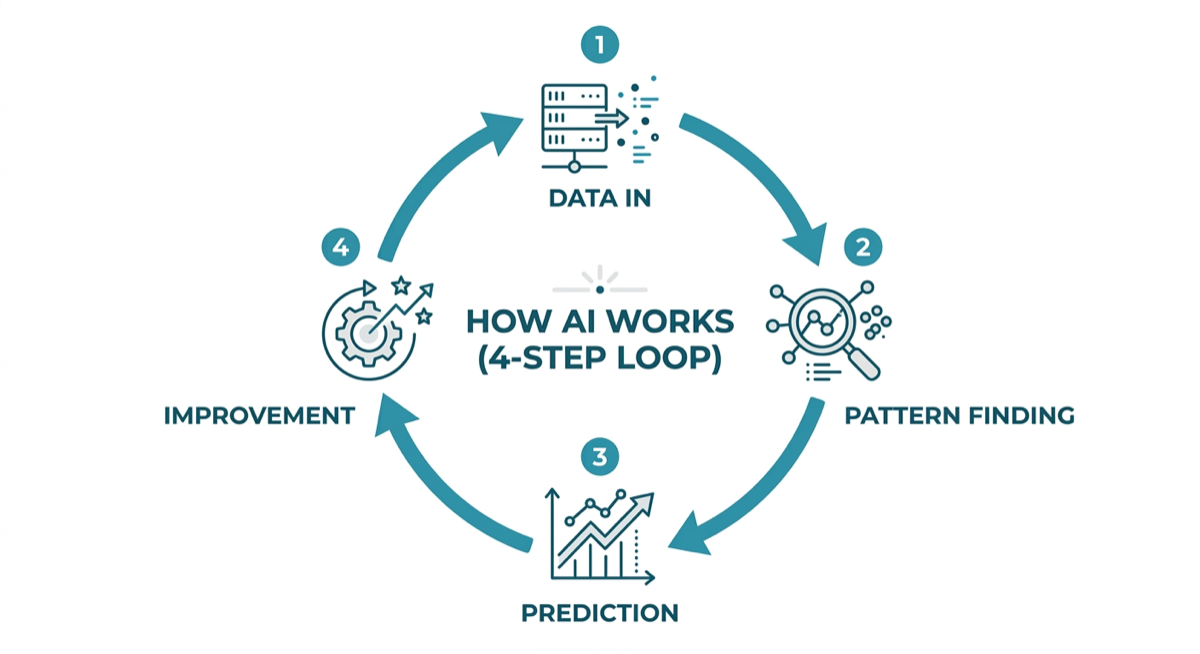
Here's the simplified version:
- Data in. AI systems learn from massive amounts of data — text, images, numbers.
- Pattern finding. They identify patterns in that data.
- Prediction. They use those patterns to make predictions or generate outputs.
- Improvement. They get better through more data and feedback.
A useful example: an AI that identifies cats in photos has "seen" millions of cat images. It learned what patterns make an image likely to contain a cat — but it doesn't actually know what a cat is. The same principle applies to autonomous driving — a self-driving car's AI has processed millions of hours of road footage to recognise pedestrians, traffic lights, and lane markings. It reacts to what it detects, but it has no understanding of why a red light means stop.
Why AI matters now
In November 2022, OpenAI released ChatGPT. For the first time, anyone could have a natural conversation with AI. It reached 100 million users in two months, the fastest-growing application in history. This wasn't just a tech product. It was a glimpse into a new way of interacting with computers.
But AI isn't new — the term was coined in 1956. So what changed? Several factors converged at the same time to make it finally work at scale:
- Computing power. Modern computers are millions of times faster than those from the 1990s.
- Data availability. The internet created vast amounts of training data.
- Algorithm breakthroughs. Researchers discovered better ways to train AI systems.
- Investment. Billions of dollars poured into AI research.
AI in your life today
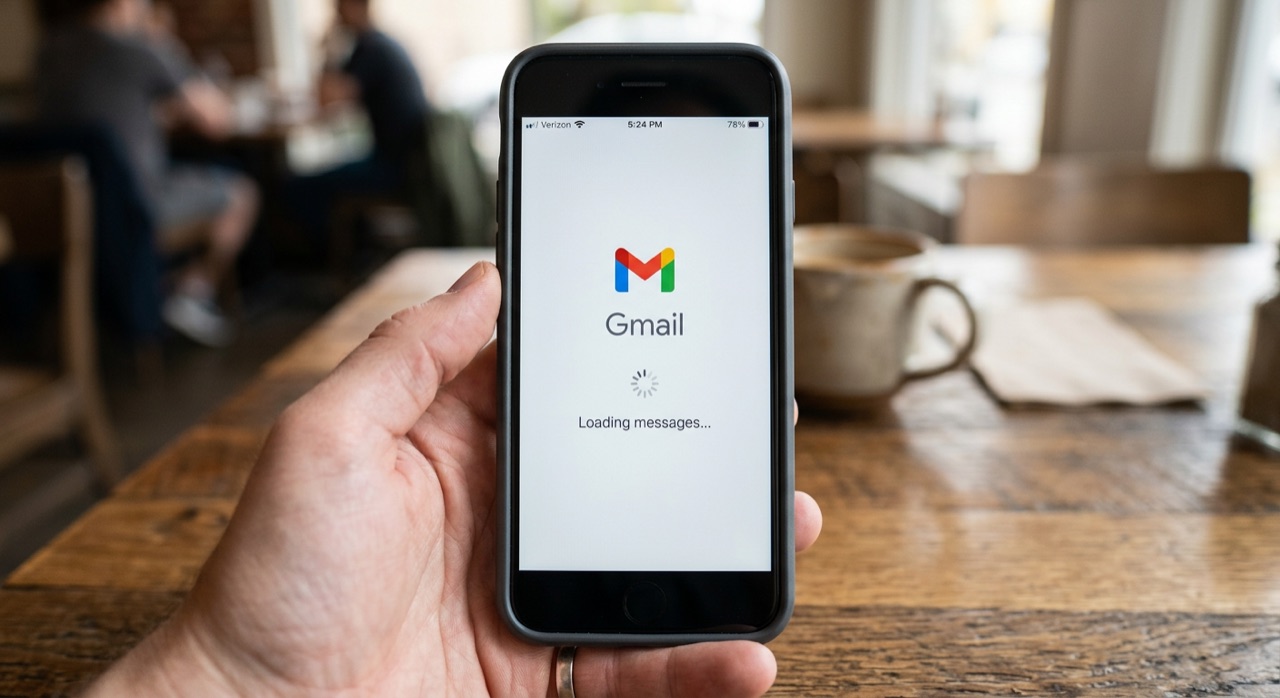
You're already using AI, probably without realising it:
- Email: Gmail's spam filter and Smart Reply
- Shopping: Amazon's "Customers also bought" recommendations
- Streaming: Netflix and Spotify suggestions
- Navigation: Google Maps predicting traffic
- Photos: Your phone organising photos by face
- Search: Google understanding your queries
- Social media: Your personalised feed
AI has been quietly making your digital life smoother for years.
Two types of AI you'll encounter
Invisible AI works quietly in the background. You never type a message to it or ask it a question, it just watches patterns and acts on them. When Gmail filters out spam before you see it, when Netflix suggests what to watch next, or when your bank flags a suspicious transaction, that's invisible AI at work. It's been part of your life for years. You just didn't notice it.
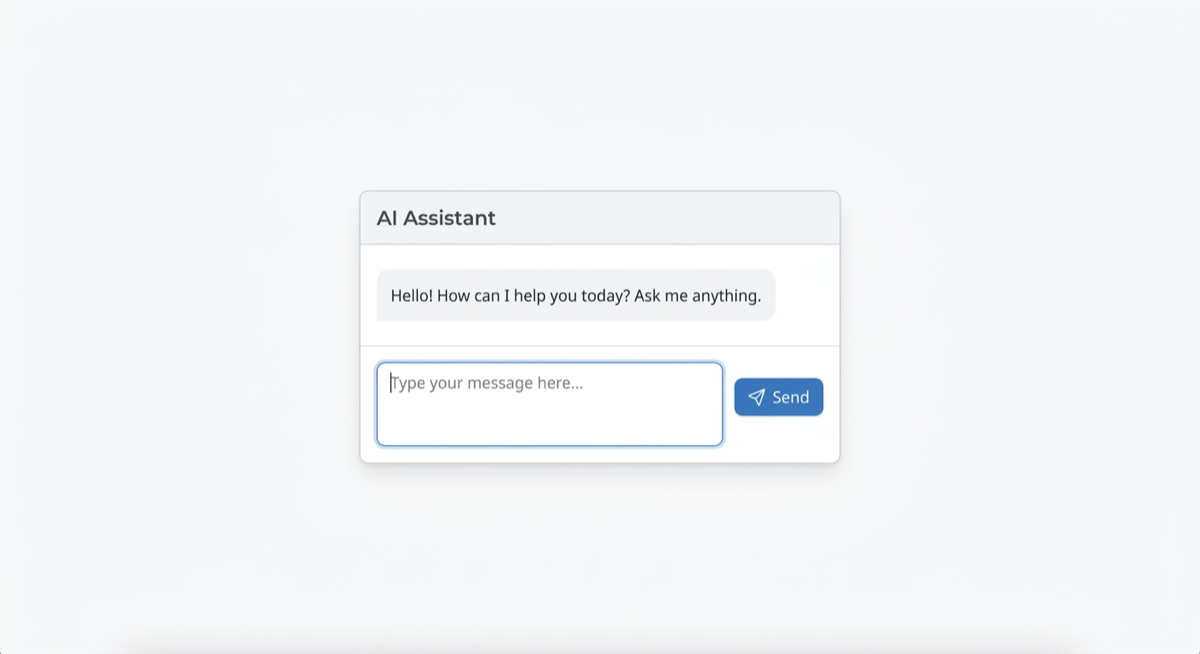
Interactive AI is the kind you actually talk to. You type or speak, it responds. It can answer questions, write content, explain ideas, help you plan — and it gets more useful the more clearly you communicate with it. ChatGPT, Claude, Gemini, Siri, and Alexa all fall into this category. This is the AI that's suddenly everywhere in the news, and for good reason: it's the first time most people can directly use AI as a tool, in plain language, without needing any technical skills.
The reason this distinction matters: invisible AI is something that happens to you, while interactive AI is something you use. And the better you understand how to use it, the more value you get from it. That's what this course is here to help with.
How AI began
AI can feel like magic — it writes, reasons, and responds in ways that seem almost human. But behind every AI tool is decades of trial, failure, and incremental progress made by thousands of researchers.
Understanding that history matters because it strips away the magic. When you know that AI has gone through multiple cycles of hype and disappointment, you're less likely to be swept up by the next wave of breathless headlines, and better placed to spot what's genuinely useful.
The rise of machine learning
Instead of programming rules, researchers asked: what if we let computers learn from data? The key insight: instead of telling AI what to know, show it lots of examples and let it figure out the patterns.
The deep learning revolution
In 2012, a deep learning system won an image recognition competition by a landslide, cutting the previous error rate nearly in half. It wasn't incremental progress — it was a revolution.
Three factors made it possible: the internet had provided billions of training examples, graphics cards could train neural networks 100x faster, and researchers had developed better techniques.
AI achievements came rapidly after that:
2014 — Generative Adversarial Networks (GANs) create realistic fake images
2016 — AlphaGo defeats the world Go champion, a feat thought to be decades away
2017 — The Transformer architecture revolutionises language processing
2018 — BERT and GPT models demonstrate real language understanding
2020 — GPT-3 generates remarkably coherent text
2021 — DALL·E creates images from text descriptions
2022 — ChatGPT brings AI capabilities to the general public
The current era
We're now in a period of rapid deployment — AI tools appearing in every industry, intense competition among major tech companies, broad public engagement, and serious questions about jobs, truth, privacy, and the future.
What history teaches us
AI's past offers clear lessons:
- Hype cycles are real. Excitement leads to disappointment, which leads to quiet progress, which leads to excitement again.
- Breakthroughs are unpredictable. Major advances often come from unexpected directions.
- Progress isn't linear. AI had two winters. There may be more.
- Practical applications matter. AI succeeds when it solves real problems, not when it impresses academics.
- We're often wrong about timelines. Both optimists and pessimists consistently misjudge when capabilities will arrive.
Key takeaways
- AI is a tool, not a sentient being — it simulates intelligence without truly possessing it
- AI learns from data by finding patterns and making predictions
- AI became powerful because computing power, data, and research converged at the same time
- You already use AI in many everyday applications
- Interactive AI like ChatGPT is now accessible to everyone
- AI has moved through boom-and-bust cycles since the 1950s
- Deep learning in 2012 kicked off the current revolution, and ChatGPT in 2022 brought it to the mainstream
- History suggests we should be excited — but cautious about predictions
Understanding what AI is is only the first step. The more important question is: should we trust it? The next course explores the ethics and safety of AI — covering bias, misinformation, privacy, and what guardrails exist today.

Nice work — you've finished the reading
Ready to lock it in? Take the quick quiz and earn your free certificate.
Back to GMAsia Campus