
The AI Resume That Actually Gets Noticed
You're not underqualified. You're unnoticed. Here's what AI can actually fix about that.
Built for small screens — bite-size cards and quick checks instead of long scrolling.
Try it interactiveAI didn't write your best work. You did.

Type your job title into an AI tool, and it'll hand you a complete resume in seconds — full bullet points, sharp phrasing, ready to send.
Reality check: some of what comes back may not be true. Testing across the most popular resume tools found something specific: ask any of them to make a bullet "more impactful," and several will quietly invent numbers. A plain input like "led a team that migrated the data pipeline" can come back as "spearheaded a 5-engineer team, reducing latency by 67% and cutting infrastructure costs by 35%" — precise, confident, and fabricated. None of those figures came from you.
AI's real job here is organizing and phrasing your actual experience — not inventing it. That distinction runs through this entire course.
The tailoring tension, resolved

Here's the honest math: tailoring a resume to each specific job meaningfully improves your odds. It's also genuinely true that most applications, tailored or not, won't convert to an interview. Spending two hours perfecting every single application isn't sustainable, and it isn't necessary either.
The fix is a tiered effort, not an all-or-nothing choice:
Tier 1 — most applications. A strong baseline resume, quickly adjusted per role: swap in the job posting's own keywords, reorder your bullets so the most relevant ones sit at the top. Minutes, not hours.
Tier 2 — the roles you actually want. Full company research, a resume genuinely rewritten around that specific role's priorities, and real interview prep. Reserve this for the handful of applications where it's worth the time — not every single one.
Knowing which tier a role deserves is itself the skill. Treat "I want this one" as a real signal, not a feeling to ignore.
Before you open any tool — gather your real material

Write down your actual numbers before you ask AI to polish anything. Team size, timeline, percentage improvement, dollar figures, user counts — whatever is real and specific to what you did. If you don't have an exact number, a defensible estimate you could explain in an interview is fine. A number you can't explain if asked is a number you shouldn't use, AI-generated or not.
A safe way to use AI here: feed it your real, specific input and ask it to sharpen the wording, not invent the substance:
"Rewrite this bullet point to be more concise and results-focused, using only the facts I've given you. Do not add any numbers, tools, or outcomes I haven't stated: [your real bullet, with your real numbers]."
That explicit instruction — don't add facts I haven't given you — is the single highest-leverage line in this entire course.
Company research and matching your CV to the job

Researching a company fast:
"Here's [Company]'s latest press release or About page: [paste]. Summarize their top 3 current priorities, and suggest one way my background in [your field] connects to them."
Matching your CV against a specific job posting:
"Here's a job description: [paste]. Here's my current resume: [paste]. List the skills and keywords in the job description that aren't reflected in my resume, so I can check if I genuinely have them and should add them."
The honest caveat on that last one: only add a skill or keyword if you genuinely have it. Matching keywords to get through an initial screen and then failing to back it up in an interview wastes everyone's time, including yours.
The tool landscape — mostly wrappers, and that's fine
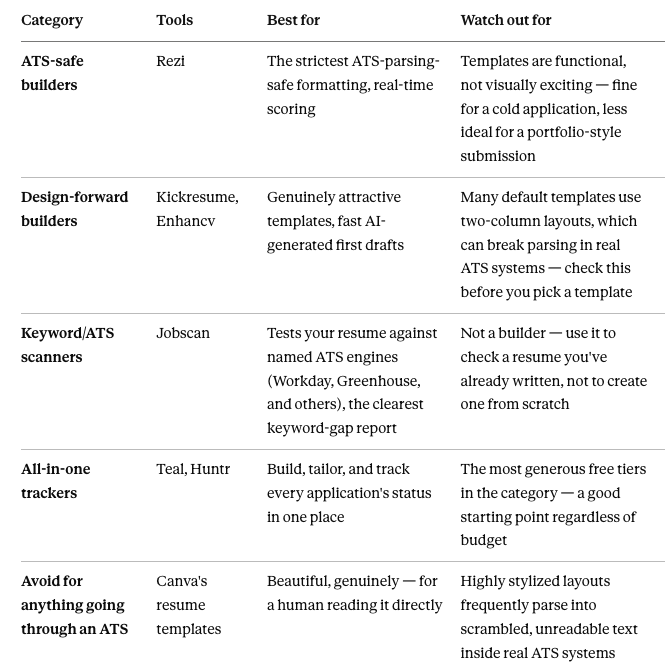
Most resume tools are built on top of a general AI model, with a specific template library, ATS-testing layer, or job-tracking feature added on top. That's not a criticism — it's exactly why picking the right wrapper for your actual need matters more than picking the "smartest" one.
Layout and file format — the part that quietly disqualifies people
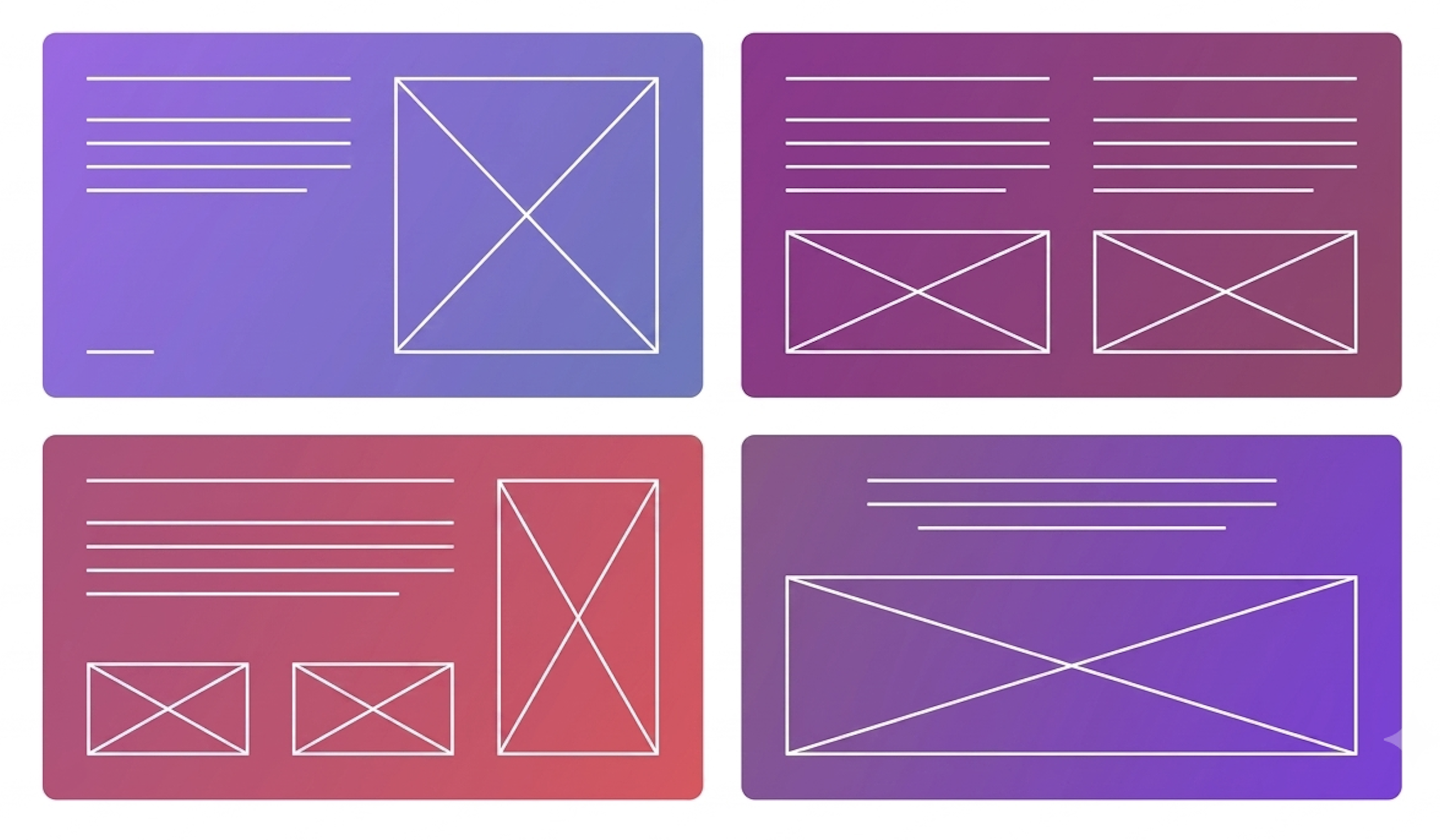
Single-column beats two-column, almost always. Many ATS engines read left to right, top to bottom — a two-column layout can scramble the reading order entirely, even if it looks perfectly clean to your eye.
Skip tables, text boxes, and heavy graphics in anything going through an online application portal. They render fine for you; many ATS parsers can't extract text from them at all.
Save it as a real, text-based PDF — not an image export. A text-selectable PDF preserves your formatting reliably across most systems. If a job posting specifically requests a .docx file, provide that instead — some older ATS engines still parse Word documents more reliably than PDF.
When design flourish is actually safe: a referral straight to a hiring manager, a creative-industry portfolio piece, anything a human opens directly rather than a cold portal upload. Know which situation you're in before choosing a template.
Passing the parser isn't the finish line

Clearing an ATS filter doesn't mean you've been noticed. It means a human might glance at what's left.
That glance is short. Commonly cited recruiting research puts initial resume reviews at well under a minute — often just seconds — before a recruiter decides whether to keep reading. Front-load for that glance: your most relevant, most recent role near the top, a job title that clearly echoes the one you're applying for, and your strongest quantified result visible without scrolling. If it's buried on page two, it may as well not exist.
Now, the tell that gets a resume mentally discounted even after a human starts reading it: it sounds like AI wrote it. Certain words and patterns have become instant flags — both to AI-detection tools some companies now run, and to recruiters who've simply read hundreds of AI-polished resumes this year alone. Watch for:
Overused corporate buzzwords — spearheaded, leveraged, synergies, dynamic, results-driven. Technically fine words, individually. In combination, they read as generic rather than specific.
Suspiciously uniform sentence structure — every bullet starting with the same verb pattern, every bullet the exact same length. Real writing has more rhythm variation than that.
Confidence with no texture. Genuine experience usually has one small, specific, slightly odd detail. Generic AI phrasing rarely does.
A prompt that actively fights genericness, instead of producing more of it:
"Rewrite this bullet point in plain, specific language. Avoid generic phrases like 'spearheaded,' 'leveraged,' or 'results-driven.' Vary the sentence structure from my other bullets, and make it sound like something a specific person would actually say about their own work — not a template."
The simplest gut-check: read the finished resume out loud. If a sentence doesn't sound like something you'd actually say about your own work, it's the sentence to fix — the exact same test worth running on any AI-assisted writing, applied here at the highest possible stakes.
Know your industry's actual norms

A generic AI template reflects generic norms — not your specific industry's. A resume format that's completely standard in tech can look thin in academia, where a longer, publication-focused CV is expected. Creative fields often expect a portfolio link to matter more than the resume format itself. Some regions and industries still have their own conventions — expected length, whether a photo is customary, how job history is framed.
Check real, recent examples from people actually in your target industry and region before trusting a generic template as the final word. AI is excellent at applying a format precisely — it doesn't know which format your specific field actually expects unless you tell it, or verify it yourself.
Interview prep with AI, and the one line not to cross

Practice tools, genuinely useful: roleplay a tough interviewer with an AI assistant, the same way you'd rehearse an objection before a sales call:
"Act as an interviewer for a [role] position at a [type] company. Ask me one behavioral question at a time, follow up on vague answers, and give me honest feedback on my response before moving to the next question."
Delivery coaching tools (a distinct category from mock-interview practice) analyze how you speak — filler words, pacing, clarity — rather than the substance of your answers. Useful as a second pass after you've practiced content, not a replacement for it.
The one line worth knowing about, and not crossing: a newer category of tool provides real-time, invisible answer suggestions during the actual interview itself, undetectable on screen share. This isn't the same as preparing beforehand — it's a live deception during a real hiring conversation, and a growing number of employers now explicitly prohibit and actively detect it. Prepare thoroughly beforehand instead; that's the version of "AI helped me interview well" that holds up once you actually have the job.
Nexa's Verdict: Hype 3/5 · Maturity 4/5 — genuinely useful for the mechanical parts of a job search: formatting, keyword matching, research, and rehearsal. The substance — your real experience, your real numbers, your real answers — was never AI's to generate, and treating it that way is the one mistake that can cost you the job once someone actually asks a follow-up question.
What you now know
AI resume tools can and do fabricate specific numbers when asked to sound "more impactful" — always supply your own real figures first.
Tailor fast for most applications; reserve deep tailoring and full research for the roles you actually want most.
Most resume tools are wrappers around a general AI model with templates or ATS-testing added — pick based on your actual need, not the flashiest option.
Two-column layouts, tables, and heavy graphics can break real ATS parsing — single-column, text-based formatting is the safer default for cold applications.
An initial human glance is short — put your most relevant role and strongest result where it's seen without scrolling.
Avoid the AI-written tell: overused buzzwords and uniform sentence structure get flagged by detectors and experienced recruiters alike — read your resume aloud and fix anything that doesn't sound like you.
Check real examples from your specific industry before trusting a generic AI template as the final word.
Use AI to rehearse and research before an interview — never to feed you live, invisible answers during the actual conversation.
Nice work — you've finished the reading
Ready to lock it in? Take the quick quiz and earn your free certificate.
Back to GMAsia Campus