
Stay Competitive in the AI Era: Career Skills That Last
Task Auditing, Value Framing, and Lasting Human Capabilities
Built for small screens — bite-size cards and quick checks instead of long scrolling.
Try it interactiveChapter 1: Finding What to Automate First
High-Value Focus: With AI tools getting powerful each day, it is important to keep asking where human work is valued most. Shifting your daily effort from basic data processing to high-value human judgment and client relationships is one of the key trend across industries.
The Task-Audit Method: Deconstructing Roles Across Legacy Silos
Most professionals describe their work using broad job titles like "Marketing Manager," "Operations Associate," or "Financial Analyst." The problem is that a job title cannot be automated only individual tasks can.
When you look closely at your weekly routine, your work is rarely confined to a single, neat software platform. Instead, your daily tasks are trapped across disparate systems, legacy desktop applications, disconnected enterprise software, and shared email inboxes.
To find real efficiency, you must deconstruct your job title into individual, single-step tasks and map how data moves between these software silos.
The "Start Small" Methodology
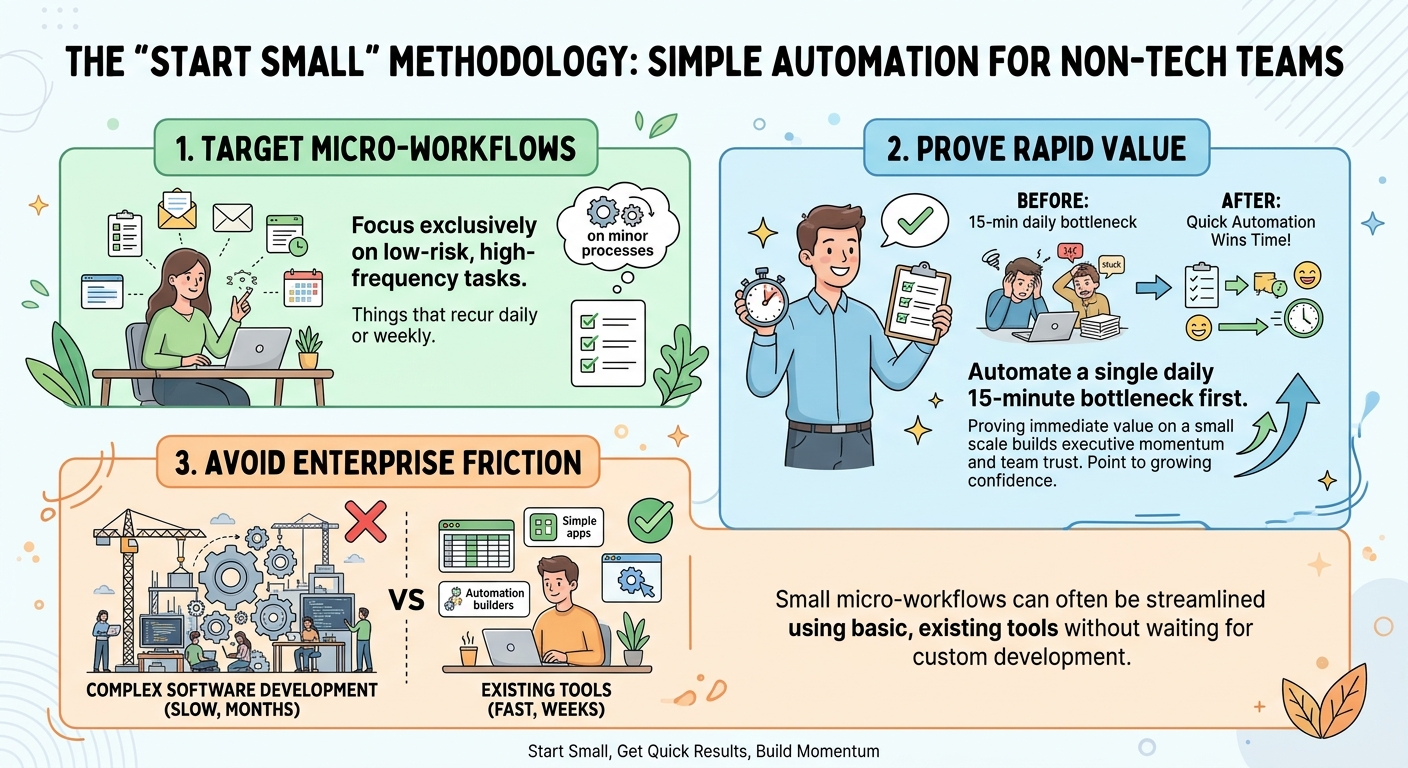
Target Micro-Workflows: Focus exclusively on low-risk, high-frequency tasks that recur daily or weekly.
Prove Rapid Value: Automate a single 15-minute daily bottleneck first. Proving immediate value on a small scale builds executive momentum and team trust.
Avoid Enterprise Friction: Small micro-workflows can often be streamlined using basic, existing tools without waiting for months of custom software development.
The Work Sorting Chart
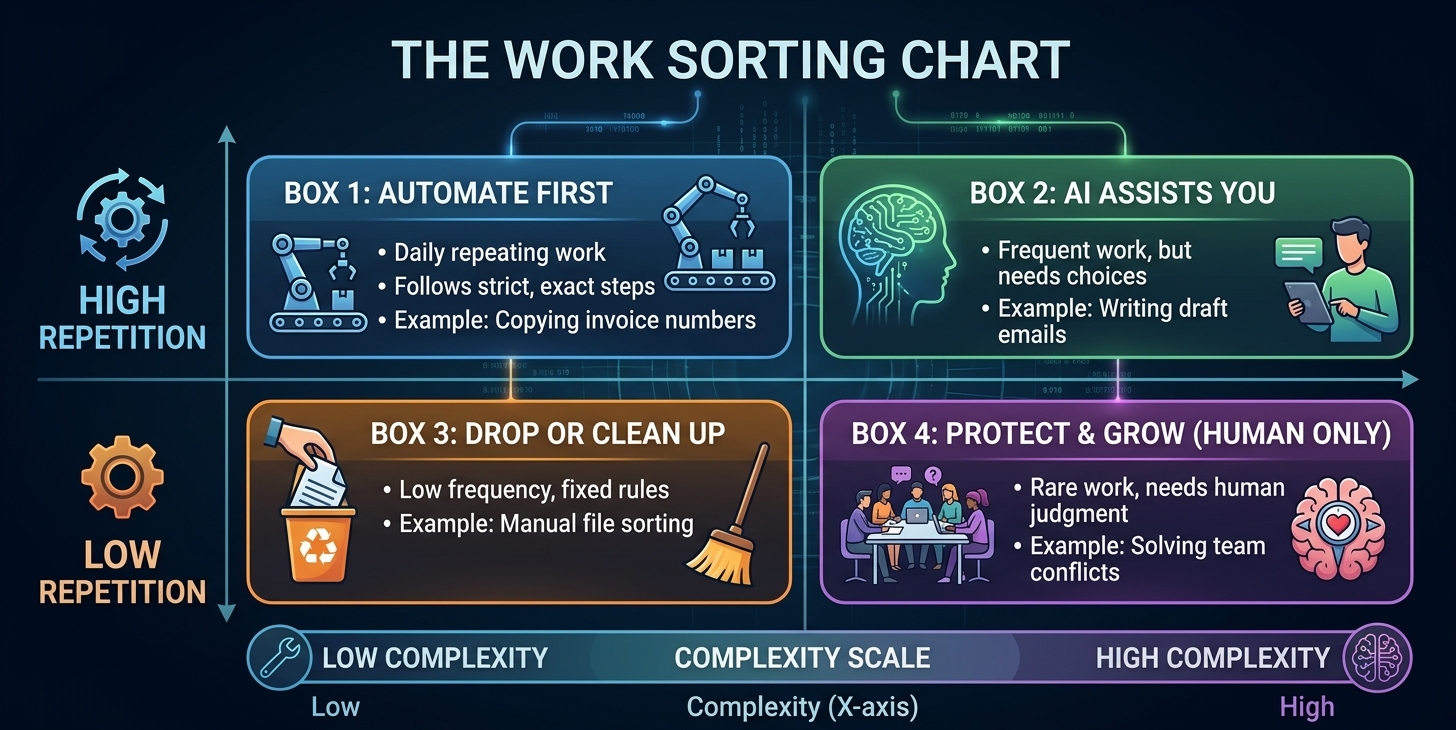
Once you list your granular weekly duties, plot each task onto the Work Sorting Chart based on two factors: Repetition (how often it occurs) and Complexity (how much human judgment it requires).
The Work Sorting Chart above shows how you can break your daily work into each of these quadrants. The goal is to give you a new set of lenses to evaluate where AI excels. By delegating these tasks to AI, it will free up more time for high-value human work.
The SOP Readiness Rule
Before moving any task from Box 1 (Automate First) into production, you must apply the SOP Readiness Rule:
A task can only be automated if a clear Standard Operating Procedure (SOP) already exists.
If a process relies on unwritten rules, vague intuition, or inconsistent steps, automating it will only produce errors faster. You must document, standardize, and clean up the step-by-step logic before introducing any AI or automation tool.
Tangible Famework
The Work Sorting & SOP Readiness: Use a task matrix used to map your weekly duties into the 4 operational quadrants and flag SOP availability.
Recommended AI Tools
General LLM: Used for task taxonomy breakdown, SOP extraction, and workflow mapping.
Notion AI: Used for documenting task audits, maintaining central SOP repositories, and tracking workflow rules.
Real-World Case Study: Logistics Operations
An Operations Associate at an international logistics firm mapped their entire weekly workload across legacy enterprise software and desktop spreadsheets. They discovered that manually opening 40 vendor PDF invoices per week, copying tracking numbers and dollar amounts into Excel, and emailing status reports to leadership consumed 12 hours per week.
Applying Chapter 1's core framework:
SOP Readiness Check: The task followed fixed, predictable steps with clear PDF data fields confirming a clean SOP existed and it was ready for automation.
Data Compliance Check: Vendor invoice totals were standard operational data, posing minimal privacy risk compared to customer personal records.
By starting small, they automated a micro-workflow that reduced a 12-hour bottleneck down to a 5-minute review, without triggering complex enterprise security reviews.
Short Takeaway: Do not try to change your whole job at once. Map your small tasks, automate the simple repeating steps, and protect your human time. Find the high-frequency, low-risk routines and start small.
Instructions
Select one repeating task from your weekly routine. Use the prompt below to break it down, place it in the Work Sorting Chart, and check if it has a clear Standard Operating Procedure (SOP) before automating.
Task SOP Evaluator
"Act as a process improvement expert. I am auditing my daily work. I have a weekly task that I classified as a high-repetition, rule-based task that I want to automate.
Here is my task description: [PASTE TASK HERE]
Evaluate SOP Readiness: Based on my description, does this task have clear, predictable step-by-step rules, or are there hidden decisions that need a human?"
Sample material
"Every Monday, I open 15 client PDF invoices, copy the invoice numbers, vendor names, and dollar amounts into an Excel spreadsheet, and then email that spreadsheet to my manager."
Check your result
SOP Evaluation: The AI should confirm that copying fixed fields from standardized PDFs has a clear, rule-based SOP ready for automation.
Chapter 2: Proving AI Value with a One Page Proposal
High-Value Focus: Elevating your professional communication from basic task updates to executive-level business proposals framing technical workflows in terms of speed, risk reduction, and financial ROI.
Moving Beyond "Labor Hours Saved"
The single biggest mistake professionals make when pitching AI initiatives to leadership is focusing entirely on labor-hour savings (e.g., "This tool saves me 4 hours of typing per week").
To an executive or manager, saved hours rarely translate directly to bottom-line profitability unless headcount is reduced which creates culture anxiety and pushback. To build a compelling business case, you must translate AI adoption into broader strategic metrics: cycle-time reduction, throughput capacity, error mitigation, and revenue velocity.
The 3-Level Value Pyramid
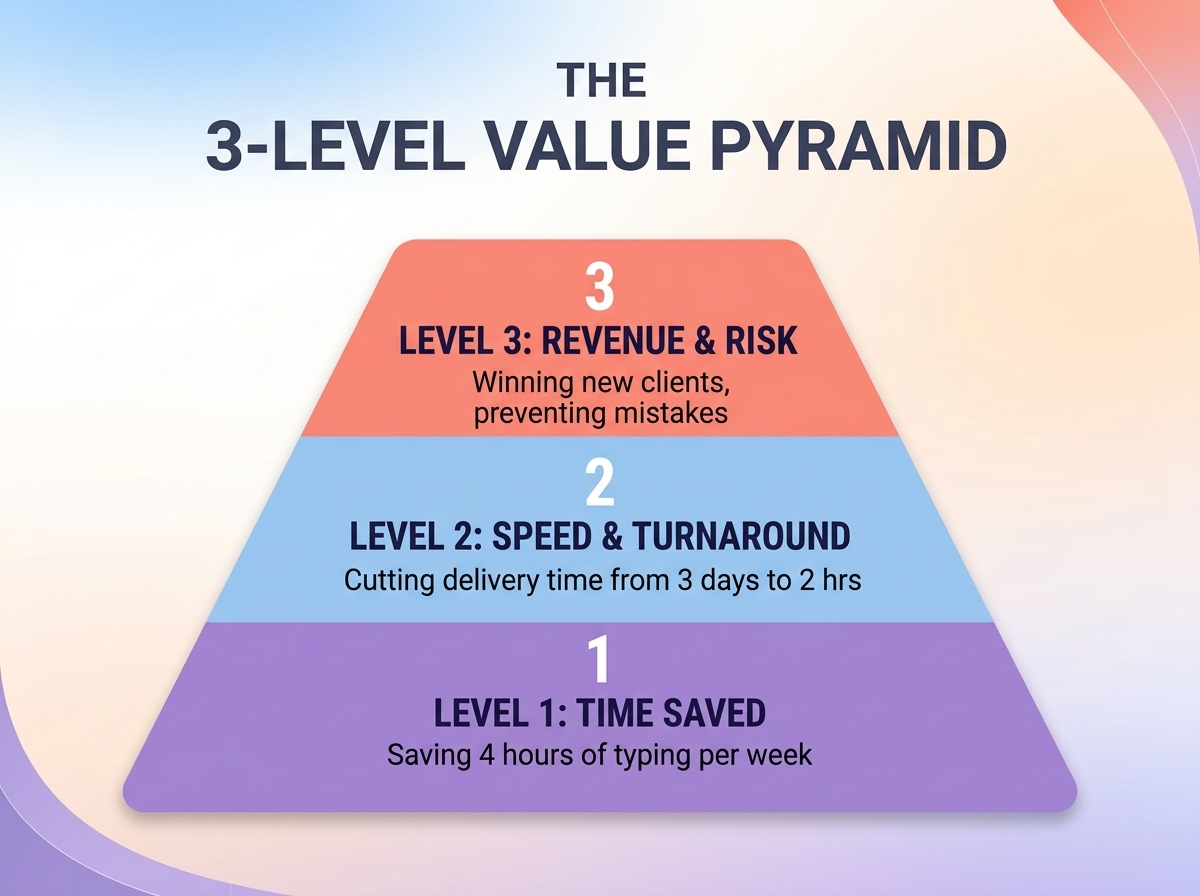
To present a bulletproof AI proposal, evaluate and communicate your initiative across three distinct layers of financial impact using the 3-Level Value Pyramid:
Level 1: Operational Time Saved
Focus: Individual productivity and task-level efficiency gains.
Example: "Adopting an AI document reader cuts financial analysis labor by 5 hours per file."
Executive Impact: Low to Moderate. (Shows personal efficiency, but doesn't prove business expansion).
Level 2: Cycle Time & Turnaround Speed
Focus: Speed of service delivery, operational velocity, and eliminating organizational bottlenecks.
Example: "Reducing review time drops overall credit decision turnaround from 5 business days down to 2 hours."
Executive Impact: High. (Improves customer experience and operational capacity).
Level 3: Revenue Expansion & Risk Mitigation
Focus: Business growth, win-rate improvement, competitive advantage, and compliance error reduction.
Example: "Faster turnaround enables us to capture high-value clients before competitors respond driving revenue growth while lowering portfolio default risk via multi-variable analysis."
Executive Impact: Highest. (Directly aligns with executive goals and budget allocation).
Framing Compute & Infrastructure Costs
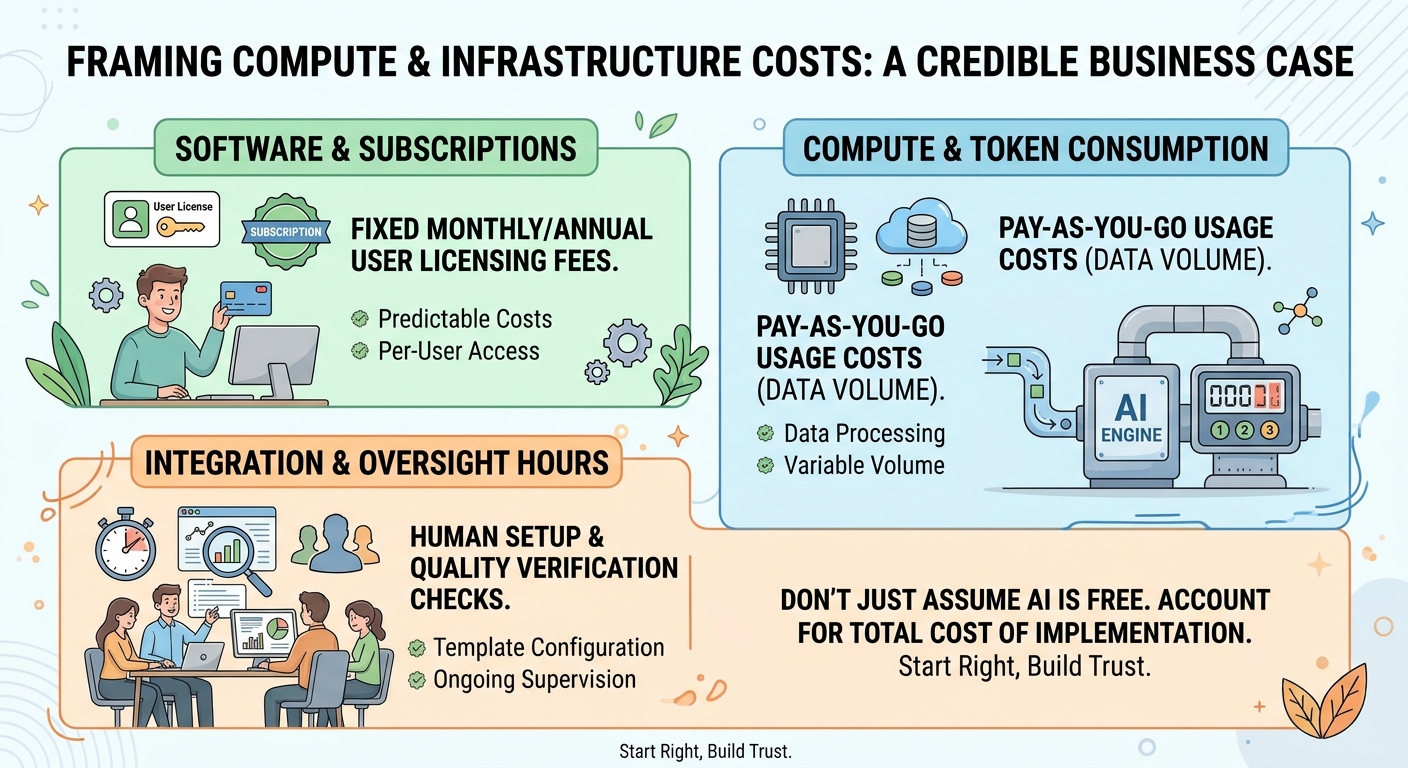
A credible business case must account for the total cost of implementation rather than pretending AI is entirely free. When presenting your proposal ("What is your case?"), outline the three cost components clearly:
Software & Subscription Costs: Fixed monthly or annual user licensing fees.
Compute & Token Consumption: Pay-as-you-go usage costs based on data processing volume.
Integration & Oversight Hours: The human oversight time required to set up templates and perform quality verification checks.
Offsetting these minor operational costs against Level 2 and Level 3 gains demonstrates strong business acumen and executive readiness.
Tangible Framework
The 1-Page Business Proposal Formula: A structured template designed to present cost, speed gains, and risk-mitigation metrics on a single executive summary page.
Recommended AI Tools
Custom ROI Calculators: For modeling cycle-time reductions and labor cost offsets.
Excel / Google Sheets AI Add-ons: For financial modeling, sensitivity analysis, and ROI chart generation.
Real-World Case Study: Commercial Banking
A Commercial Banking Analyst recognized that manually synthesizing 100-page financial statements, tax filings, and market reports to draft credit memos was creating a severe operational bottleneck.
Instead of submitting a request for AI tools by stating "it will save analysts 5 hours per report," the analyst built a proposal using the 3-Level Value Pyramid:
Level 1 Gain (Time): Saves 5 analyst hours per credit file, freeing up 20 analyst hours per week.
Level 2 Gain (Speed): Cuts loan decision turnaround from 5 days down to 2 hours (a 60% overall reduction in processing cycle time).
Level 3 Gain (Revenue & Risk): Fast turnaround allows the bank to secure high-value commercial borrowers before rival institutions can respond contributing to $18M in new loan originations while reducing default risk through standardized multi-variable risk checks.
Outcome: Executive leadership approved the budget for the AI initiative because the proposal proved direct revenue expansion rather than just saved labor hours.
Short Takeaway: To secure budget or leadership buy-in, never frame AI success around saved hours alone. Always measure and pitch success in cycle times, error reduction, and revenue growth.
Instructions
Select an AI workflow idea for your current role or team. Use the prompt below in a LLM of choice to transform raw task details into a structured, executive-ready 1-Page Business Proposal based on the 3-Level Value Pyramid.
1-Page AI Business Case Generator
Act as an executive business consultant. I want to pitch an AI workflow implementation to my leadership team. Turn my raw operational details below into a concise, structured 1-Page Business Proposal.
Organize the proposal using the 3-Level Value Pyramid:
- Level 1: Time Saved (Task-level efficiency)
- Level 2: Speed & Turnaround Gain (Cycle-time reduction)
- Level 3: Revenue Expansion & Risk Mitigation (Strategic business impact)
Include a brief section estimating total implementation costs (licenses, tokens, oversight) vs. expected gains. Keep the total output under 250 words in clear, professional language.
My Operational Details: [PASTE DETAILS HERE]
Sample material
Our client onboarding team takes 4 days to process incoming enterprise account applications because we manually verify corporate filings, tax documents, and ID records. We process about 25 applications a week. Potential clients frequently abandon the application process if turnaround takes longer than 48 hours, costing us sales deals.
Check your result
Level 1 (Time): Quantifies individual verification hours saved per application file.
Level 2 (Speed): Highlights dropping overall account onboarding turnaround reduction leads to effective task output.
Level 3 (Revenue/Risk): Frames the financial gain around capturing lost client sales and eliminating manual verification compliance errors.
Chapter 3: Systems Architecture – Multi-Modal Workflows & Data Governance
High-Value Focus: Moving beyond basic standalone chat tools by designing end-to-end multi-modal workflows that securely process real-world inputs directly into core enterprise systems.
Multi-Modal Pipelines: Beyond Single Text Prompts
True workplace productivity rarely happens in a single text-chat box. High-value business processes rely on multi-modal workflows simultaneously ingesting, processing, and outputting multiple data formats across text, vision (images/documents), audio (voice notes), and structured databases.
Instead of manually summarizing a document, then typing a separate email, and then updating a database entry, multi-modal pipelines chain these steps together into a single, automated flow.
Basic Systems Feasibility for Non-Technical Leaders
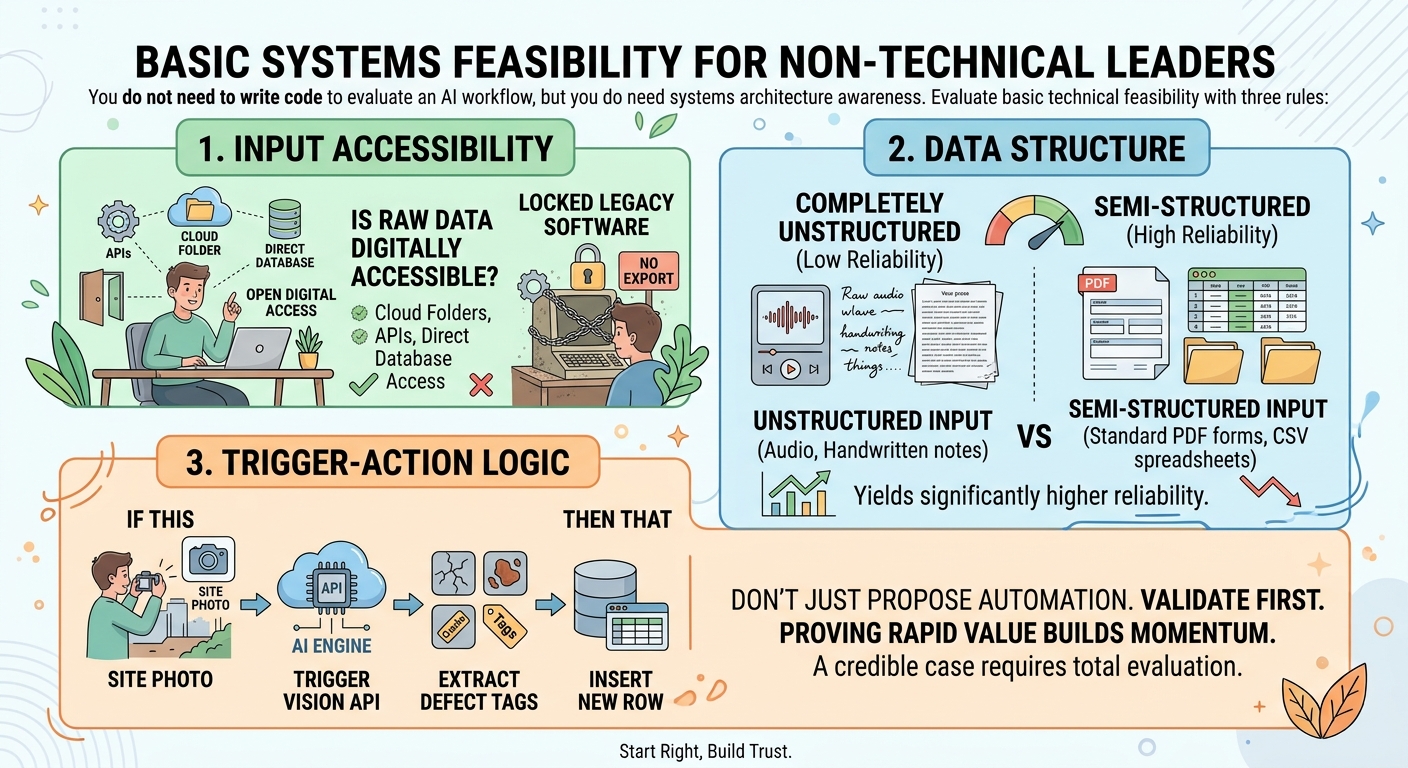
You do not need to write code to evaluate an AI workflow, but you do need systems architecture awareness. Before proposing an automated pipeline, evaluate basic technical feasibility using three rules:
Input Accessibility: Is the raw data accessible digitally (APIs, direct database access, cloud folders), or is it locked behind restricted legacy software with no export options?
Data Structure: Is the input completely unstructured (raw phone audio, handwritten notes) or semi-structured (standard PDF forms, CSV spreadsheets)? Semi-structured data yields significantly higher reliability.
Trigger-Action Logic: Can the process be mapped as a clear "
If This, Then That"chain? (e.g., If a new site photo is uploaded to Google Drive, trigger the vision API, extract key defect tags, and insert a new row into the maintenance database).
If your workflow passes these three checks, it is technically feasible using low-code automation tools (e.g., Zapier, Make.com) or standard web APIs.
Data Governance & Enterprise Compliance (GDPR, SOC2, HIPAA)
Connecting modern AI tools to company infrastructure introduces strict regulatory responsibilities. Feeding confidential client data into unvetted public models can result in severe legal and compliance breaches.
Every multi-modal pipeline must enforce four enterprise governance layers:
PII Masking (Personally Identifiable Information): Stripping or obfuscating names, credit card numbers, national IDs, and phone numbers before data reaches an external language or vision model.
SOC2 Type II Readiness: Ensuring third-party AI vendors and middleware platforms encrypt data both in transit and at rest, maintaining strict access control logs.
GDPR Compliance (Data Privacy & Sovereignty): Guaranteeing client data processed through AI APIs is not retained, stored permanently on external servers, or used to train public foundation models.
HIPAA Compliance (Healthcare Data): Ensuring any patient health information (PHI) processed by multi-modal pipelines goes through business associate agreement (BAA)-signed, encrypted endpoints.
Tangible Framework:
The Systems Feasibility & Compliance Checklist: A 5-point audit sheet used to verify data accessibility, system compatibility, PII protection, and vendor privacy policies prior to pipeline deployment.
Recommended AI Tools
Zapier / Make.com: Low-code platforms for chaining multi-modal triggers and actions between tools.
Claude (Vision Capabilities): For analyzing complex documents, blueprints, and visual inspection photos.
Whisper / Otter.ai: For converting raw voice notes and meeting audio into structured, actionable text.
Real-World Case Study: Field Engineering Work Orders
A Field Engineering Specialist at an infrastructure management firm was spending 10 hours a week writing technical equipment repair tickets after conducting physical site inspections.
They constructed a multi-modal automated pipeline using low-code tools:
Multi-Modal Input: While on site, the engineer captures a photo of damaged machinery using a mobile phone and records a 30-second voice memo describing the issue.
System Processing & PII Masking: The image and audio pass through an API pipeline. An automated script scrubs any client contact information or location tags to ensure GDPR compliance. A vision model identifies the machine part, while an audio model transcribes the verbal assessment.
Structured Database Output: The pipeline automatically formats the combined visual and text analysis into a standardized repair ticket, submitting it directly into the firm’s legacy SQL inventory database and notifying the repair team.
Outcome: Inspection ticket creation time dropped from 45 minutes per site down to 3 minutes, saving 8+ hours per week while keeping all enterprise client data fully compliant.
Short Takeaway: True organizational productivity comes from connecting multi-modal AI directly into existing enterprise databases, held together by strict data compliance and clear system architecture.
Chapter 4: The Verification Protocol – Critical Thinking & Risk Governance
High-Value Focus:
Elevating your position from a routine content writer or analyst to an authoritative output auditor, risk manager, and quality safeguard.
The Real Human Value: Output Verification Over Generation
In an era where generative AI models can produce thousands of words or code lines in seconds, the cost of generating first-draft content has dropped to zero. As a result, the primary value of a skilled professional is no longer draft creation it is critical thinking, logic verification, and risk governance.
AI models are probabilistic prediction engines, not truth databases. They frequently generate plausible-sounding falsehoods (hallucinations), misapply logic, or omit critical edge cases. Your job as an AI orchestrator is to establish a rigorous "human-in-the-loop" framework that audits AI outputs before they reach clients, leadership, or public deployment.
The Personal Context Vault
Unreliable AI outputs are rarely the fault of the AI model alone; they are usually caused by a lack of organizational context. A Personal Context Vault is a structured, central repository of rules, tone guidelines, regulatory boundaries, and formatting standards that you supply to an AI model alongside your prompt. By feeding your Context Vault into every major workflow, you reduce hallucinations, eliminate generic fluff, and enforce strict organizational alignment.
The 3-Step AI Dialogue Pattern
Treating AI as a static "search box" where you ask one question and accept the first answer leads to shallow results. High-value professionals use a 3-Step AI Dialogue Pattern to refine logic iteratively:
Role & Context Setting: Define the exact persona, business goals, constraints, and Context Vault rules.
Draft & Self-Critique: Ask the AI to generate a first draft and immediately critique its own output against explicit quality criteria.
Refine & Verify: Direct the AI to fix the identified gaps, then perform a final human review.
The 4-Step Quality Checklist
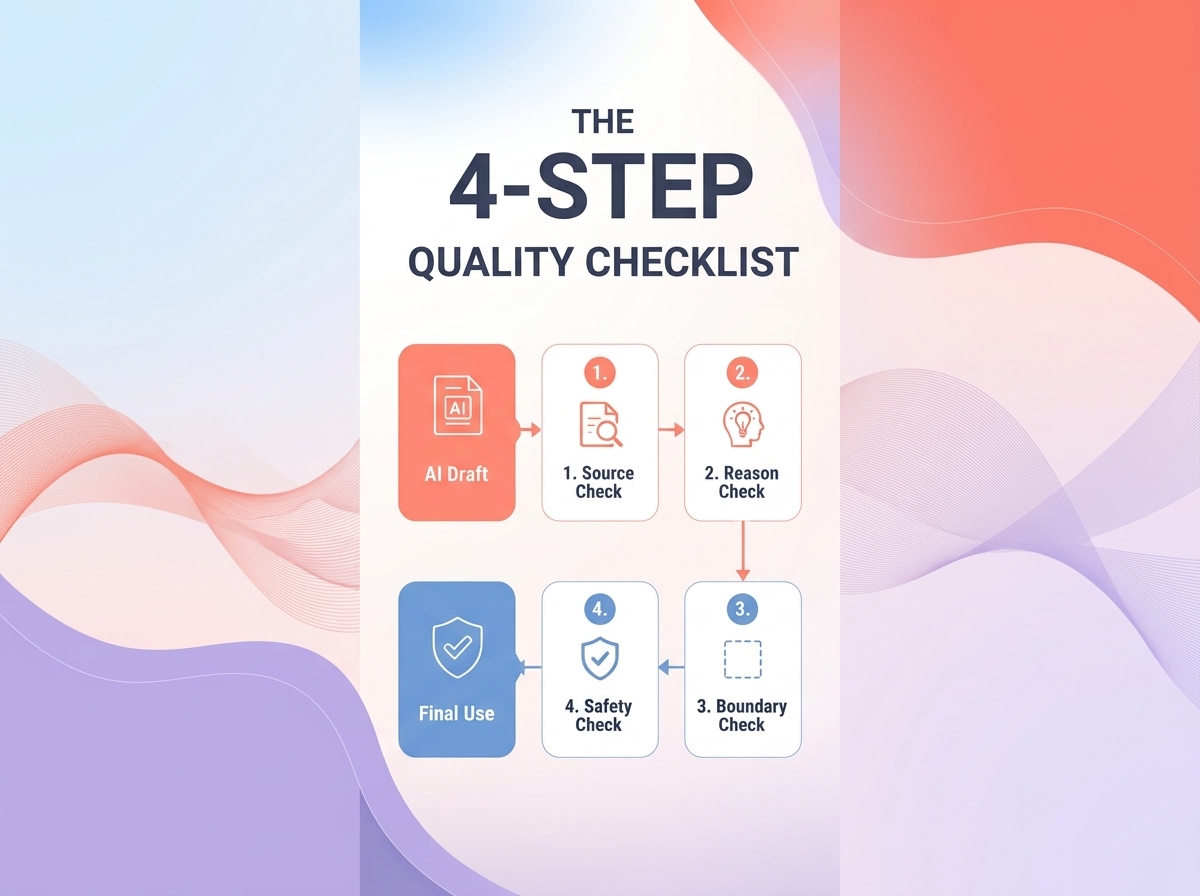
Before approving any AI-generated output for professional use, run it through the 4-Step Quality Checklist:
Begin with a Source Check to verify that all facts, statistics, and citations are backed by legitimate primary sources rather than fabricated links or records. Next, perform a Reason Check to audit the underlying logic, ensuring the response is free from hidden contradictions, flawed assumptions, or reasoning gaps. Follow this with a Boundary Check to confirm that the material strictly complies with corporate policies, legal regulations, and industry governance standards. Conclude with a Safety Check to guarantee that all personally identifiable information (PII) and confidential customer data have been thoroughly masked or stripped from the document.
Tangible Framework:
The Output Verification Protocol Template: A fillable auditing checklist for testing AI logic, checking citations, catching subtle hallucinations, and enforcing compliance.
Recommended AI Tools
Perplexity AI: For real-time fact-checking and verifying citations against primary web sources.
Claude (Artifacts & Code Sandbox): For running logic audits, parsing large document sets, and self-critique dialogue loops.
GitHub Copilot: For automated code reviews, syntax checking, and security vulnerability scanning.
Real-World Case Study: Legal & Regulatory Auditing
A Senior Legal Specialist at a global consultancy used AI to summarize complex regulatory compliance updates across three distinct international jurisdictions. Knowing the risk of AI hallucinated legal citations, the specialist executed Chapter 4's protocols:
Context Vault Injection: Supplied jurisdiction-specific legal definitions and company disclosure guidelines.
Dialogue Loop with Self-Critique: Prompted the AI to generate a summary matrix and explicitly flag any statutory reference that lacked 100% certainty.
The 4-Step Quality Checklist: During the Source Check, the specialist cross-referenced citation numbers against official government court dockets using Perplexity AI.
Outcome: The specialist caught two hallucinated section numbers in the AI's initial draft that looked entirely authentic. By acting as the "human-in-the-loop" auditor, they prevented a major compliance error while still completing a 20-hour research task in under 3 hours.
Short Takeaway: AI accelerates output generation; your true professional value lies in output verification, logical reasoning, and risk governance.
Chapter 5: Human-Centric Leadership – Communication, Taste & Trust
High-Value Focus: Positioning yourself as a high-trust leader who resolves organizational bottlenecks, bridges communication gaps between technical and business teams, and navigates change management with empathy.
The Human Edge: Empathy Beats Automation
As AI models handle increasingly complex data processing and administrative drafting, technical skills alone are no longer a long-term competitive moat. True leadership in an AI-integrated workplace requires capabilities that algorithms fundamentally lack: emotional intelligence, nuanced negotiation, creative taste, and cross-departmental trust.
When organizational problems arise, they are rarely caused by a lack of information. They are caused by conflicting incentives, fear of change, and ambiguous stakeholder expectations. AI can process noisy data, but humans must supply the empathy and diplomacy to align people around decisions.
Translating Messy Stakeholder Demands into Technical Prompts
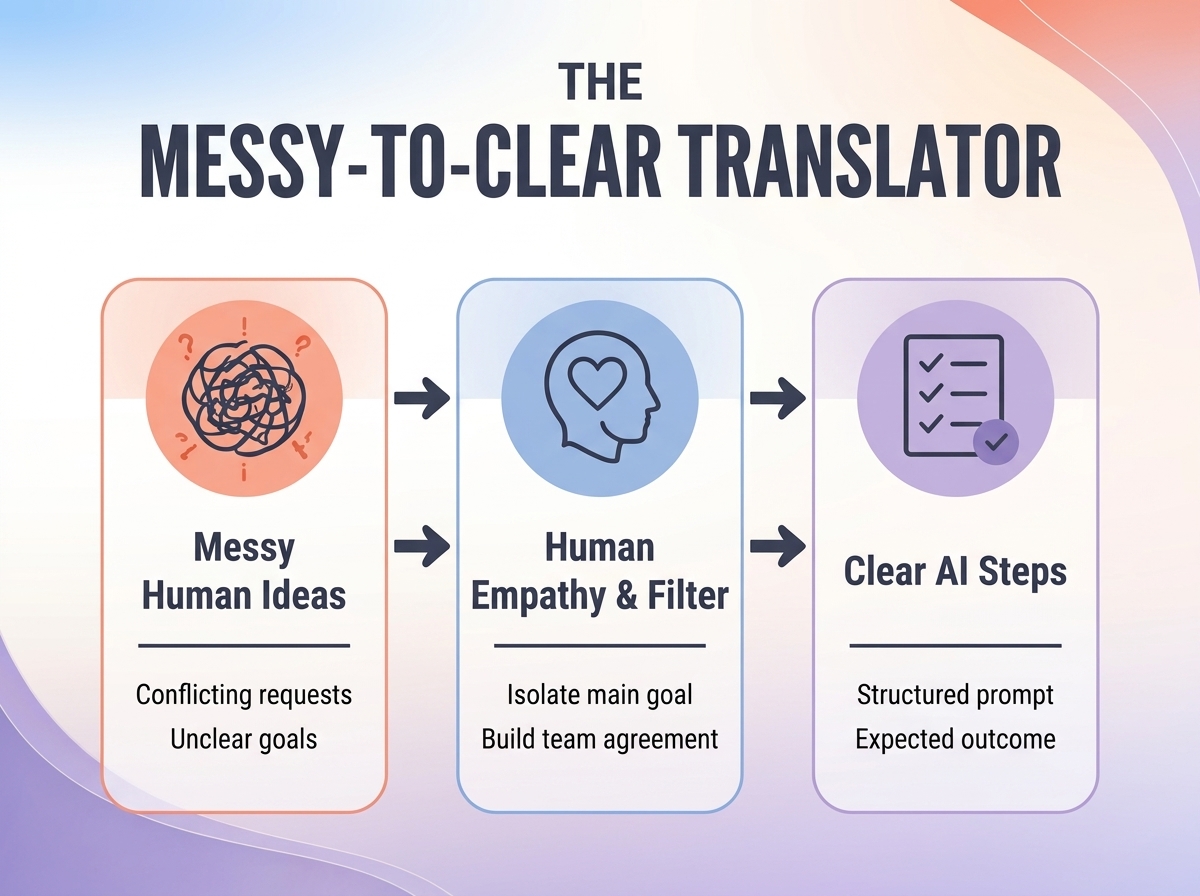
One of the most valuable leadership skills in modern business is acting as a bridge between human ambiguity and AI execution. Stakeholders rarely express what they need in clean, structured instructions; they express feedback through emotional, conflicting, or vague requests.
Leading AI-Anxious Teams & Psychological Safety
Introducing AI tools into a team frequently triggers anxiety around job security, skill obsolescence, and increased performance pressure. Effective leaders do not dismiss these fears or mandate tool adoption by decree.
To build psychological safety and drive successful adoption:
Focus on Augmentation, Not Replacement: Frame AI as an assistant that absorbs repetitive Box 1 tasks so team members can focus on high-leverage Box 4 judgment.
Normalize Imperfection: Encourage open discussion around AI errors, hallucinations, and limitations so employees feel safe auditing and questioning AI outputs.
Reward Orchestration & Oversight: Recognize and elevate team members who design better workflows, catch critical errors, and improve processes rather than those who simply output high volumes of raw content.
Tangible Framework
The Messy-to-Clear Request Translator: A structured framework for distilling conflicting team feedback into aligned project roadmaps and precise AI prompts.
Recommended AI Tools
Otter.ai / Fathom: Meeting intelligence tools for capturing raw stakeholder discussions, extracting key action items, and tracking sentiment.
General LLM: For roleplaying difficult conversations, testing negotiation strategies, and framing sensitive team announcements.
Real-World Case Study: Stakeholder Alignment in Product Operations
An Operations Manager at an e-commerce firm was tasked with launching a new client portal. During stakeholder alignment sessions, three department leads provided wildly conflicting feedback:
Sales Lead: "We need a massive, detailed dashboard showing every single feature so clients see full value."
Customer Support Lead: "No, keep it ultra-simple with 2 buttons! If it’s too complex, our team will be flooded with support tickets."
Compliance Lead: "I don't care about the layout, as long as terms of service updates are explicitly acknowledged before login."
Instead of picking a side or trying to build three separate portals, the manager applied Chapter 5's translation framework:
Meeting Synthesis: Ran raw meeting transcripts through an AI analysis tool to extract core underlying requirements vs. stylistic preferences.
Human Diplomacy & Trade-offs: Identified that all three leads shared a common goal: rapid client onboarding without support overhead or legal risk. The manager proposed a clean, 2-button landing page (Support requirement) with an expandable technical drawer (Sales requirement) and a mandatory initial terms modal (Compliance requirement).
Structured Execution: Drafted a single, aligned technical specification for the engineering and design teams.
Outcome: Resolved a 3-week departmental deadlock in a single 30-minute review session, building strong cross-functional trust while moving the project forward.
Short Takeaway: Let AI process noisy information; use human empathy, taste, and communication to build consensus, solve team conflict, and establish trust.
Chapter 6: Fortifying Your Career – The 50/30/20 Learning Strategy & Reference Guide
High-Value Focus
Building a long-term personal upskilling roadmap that insulates your career against automation by mastering the spaces between tools architecture, domain expertise, and human systems.
Navigating Technological Displacement: The Shift to Architecture
Staying competitive in an era of rapid AI deployment is not about learning every new tool that launches on social media. Tools, interfaces, and specific model prompts change monthly.
To build a career resilient to technological displacement, you must continuously shift your personal skill set away from routine execution toward high-leverage domain judgment, cross-field synthesis, and workflow architecture.
The 50/30/20 Learning Strategy
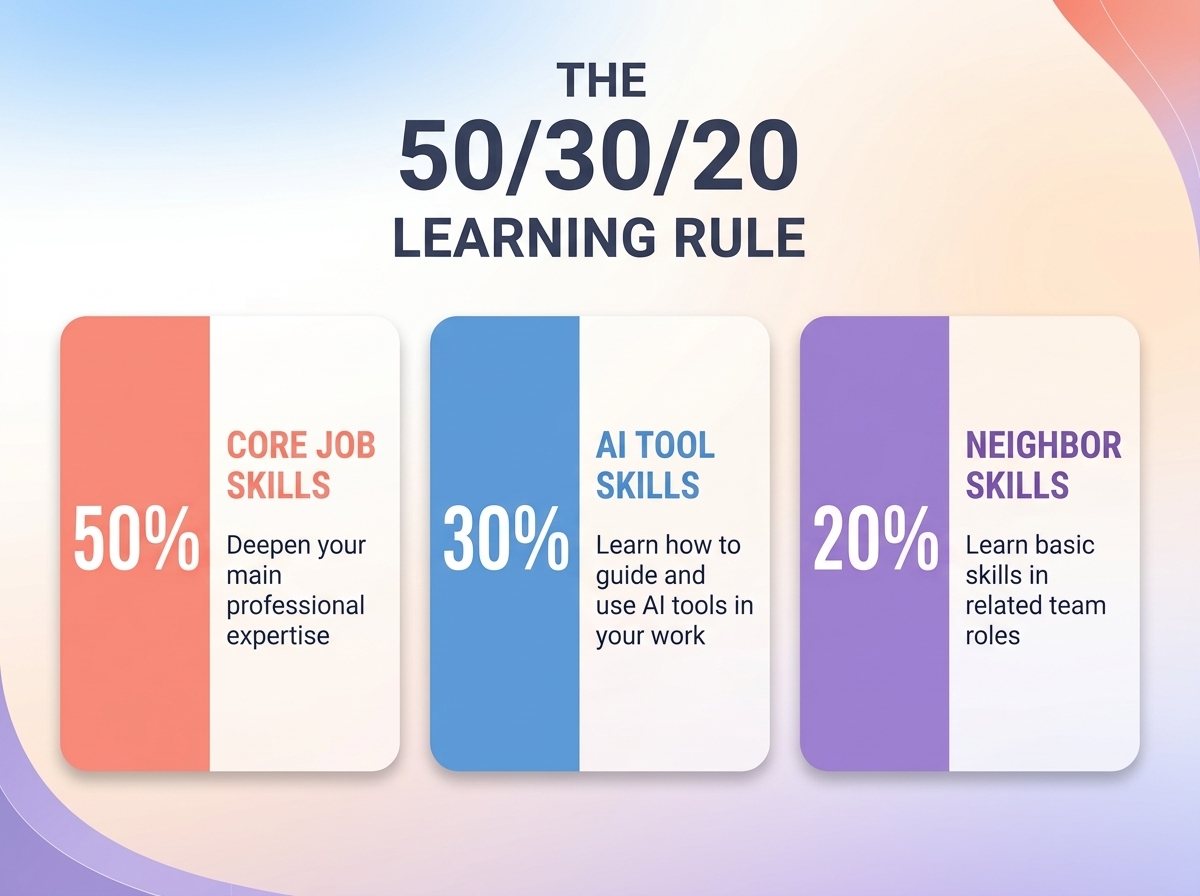
To ensure your upskilling effort is sustainable and balanced, avoid dedicating 100% of your time to chasing AI trends. Instead, structure your ongoing professional development using the 50/30/20 Learning Strategy:
First, dedicate 50% of your time to Core Domain Mastery, focusing on the deep, industry-specific expertise—such as employment law, finance principles, engineering fundamentals, or clinical protocolsthat serves as your primary value anchor and foundational edge. Next, invest 30% in AI Tool Orchestration to build applied automation capabilities, master prompt engineering, manage multi-modal pipelines, and execute quality verification checks that accelerate your output. Finally, allocate the remaining 20% to Adjacent Field Expansion by learning complementary skills that bridge departmental silos, such as basic data analytics for HR professionals, product management fundamentals for software developers, or financial ROI modeling for marketers.
Essential Reference Reading & Curriculum Library
To deepen your strategic understanding beyond practical workflows, ground your ongoing learning in foundational literature across economic impact, human-AI orchestration, and systems infrastructure:
Core AI Strategy & Economic Impact
Prediction Machines: The Simple Economics of Artificial Intelligence (Ajay Agrawal, Joshua Gans, Avi Goldfarb)
Explains how AI lowers the economic cost of prediction while exponentially increasing the value of human judgment, intent, and decision-making.
The Second Machine Age (Erik Brynjolfsson, Andrew McAfee)
Foundational perspective on technological displacement, task redefinition, and organizational transformation.
Practical Orchestration & Skill Building
Co-Intelligence: Living and Working with AI (Ethan Mollick)
Practical strategies for integrating LLMs into daily professional workflows as a thought partner, collaborator, and co-worker.
Becoming an AI Orchestrator (Sadie Kay St Lawrence)
Focuses on bridging technical execution with strategic leadership and operational oversight.
Systems Architecture & Data Governance
Designing Data-Intensive Applications (Martin Kleppmann)
The definitive technical reference for understanding data flow, system integrity, middleware integrations, and bridging modern interfaces with legacy databases.
Tangible Framework
The 12-Month Personal Career Fortification Roadmap: A structured matrix to audit your career vulnerability, set learning goals across the 50/30/20 split, and track quarter-by-quarter progress.
Recommended AI Tools
Perplexity AI: For continuous literature curation, industry research, and monitoring tool developments.
Notion: For building your personal knowledge management system and Context Vault repositories.
Real-World Case Study: Career Transition in Software Engineering
A Mid-Level Software Developer observed that routine code generation, syntax debugging, and basic unit testing were increasingly being handled by automated AI assistants. Recognizing that pure execution roles were declining in value, they executed a 12-month career fortification plan using the 50/30/20 strategy:
50% Core Domain Focus: Deepened their knowledge of secure system architecture, cloud infrastructure resilience, and cybersecurity protocols.
30% AI Orchestration: Mastered AI coding assistants, automated test generation pipelines, and code verification frameworks.
20% Adjacent Expansion: Spent time learning fundamental product management, customer research frameworks, and business ROI modeling.
Outcome: Within one year, the developer transitioned into a Technical Product Manager role. Rather than competing with automated code generation tools, they now architect multi-modal systems and align engineering capability with business strategy doubling their operational leverage.
Key Takeaway
Fortify your career by mastering the spaces between tools: domain expertise, system architecture, human leadership, and continuous cross-functional learning.
The 6 Core Capabilities You Have Mastered In This Course:
Granular Task Auditing: Deconstruct roles across software silos and automate low-risk, high-frequency tasks with clean SOPs.
Executive Financial Positioning: Build data-driven proposals using the 3-Level Value Pyramid to prove ROI through cycle speed, revenue growth, and risk reduction.
Compliant Systems Architecture: Design multi-modal workflows connecting raw inputs to enterprise databases under strict SOC2, GDPR, and HIPAA standards.
Rigorous Quality Governance: Serve as an authoritative "human-in-the-loop" auditor using Context Vaults and the 4-Step Quality Checklist to catch hallucinations.
Human-Centric Leadership: Bridge communication gaps between business and technical teams, resolve messy stakeholder feedback, and navigate team AI anxiety.
Strategic Career Resilience: Direct your long-term career using the 50/30/20 Learning Strategy, ensuring your primary value remains anchored in high-leverage judgment and architecture.
Instructions
Input your current job title and target career goal. Generate a balanced 12-month learning split using the 50/30/20 Learning Rule (50% Core Domain, 30% AI Tools, 20% Neighboring Skills).
50/30/20 Career Strategy Generator
"Act as a career strategist. My current role is [INSERT ROLE] and my 12-month goal is [INSERT GOAL]. Using the 50/30/20 Learning Rule, create a personalized 12-month upskilling plan. Break down specific topics or skills I should focus on for: 50% Core Job Skills, 30% AI Tool Orchestration, and 20% Neighboring Team Skills. Here are my details: [PASTE DETAILS HERE]"
Sample material
Current Role: HR Coordinator. 12-Month Goal: Move into a Senior HR People Operations Manager role where I lead team strategy and onboarding systems.
Check your result
50% Core Domain: Focuses on advanced HR strategy, employment law, and organizational design.
30% AI Orchestration: Focuses on AI-assisted resume screening, automated onboarding workflows, and policy Q&A bots.
• 20% Neighboring Skills: Focuses on basic data analytics, budget planning, and project management.