
How to Build Your Brand in 1 Day with AI: Part 2
Turn your Brand Brief into a living brand: guidelines, a live website, social profiles, and two weeks of content, all in a single day with AI.
Built for small screens — bite-size cards and quick checks instead of long scrolling.
Try it interactiveChapter 1: From Decisions to Things
In Part 1, you made decisions: a stress-tested concept, a positioning statement, a personality, a name you actually own, a visual direction — all compressed into your Brand Brief. Part 2 is where decisions become things people can visit, follow, and buy from.
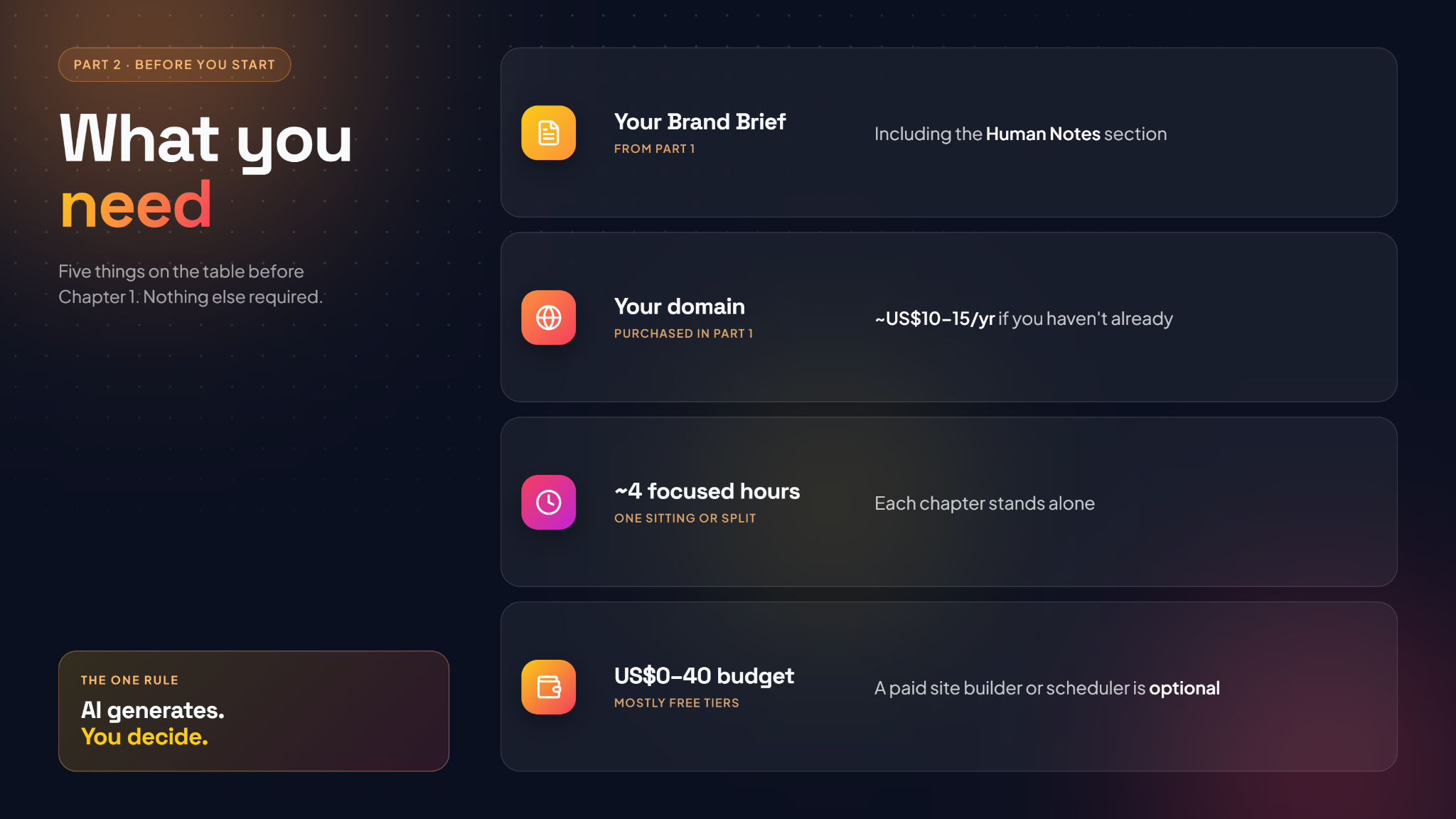
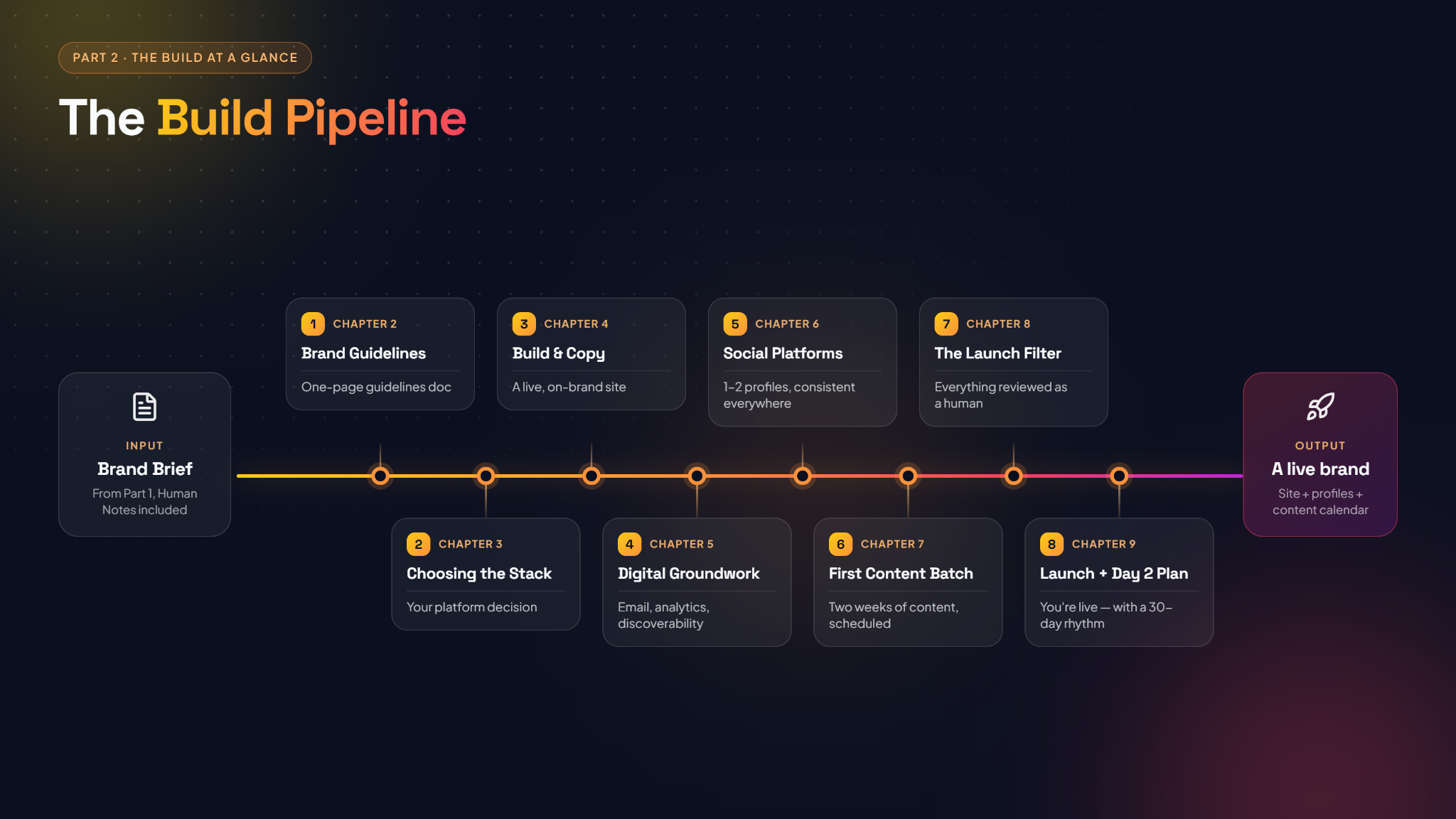
By the end of this course, your brand will have: a one-page set of brand guidelines, a live website on your domain, active social profiles with a two-week content runway, and the digital groundwork (email, analytics, discoverability) that makes it all real. Roughly a four-hour build, done in one sitting or spread across a few sessions — the chapters are self-contained, so work at your own pace.
The Brand Brief is the fuel
Every chapter in Part 2 starts the same way: paste your Brand Brief. That document is what stops the AI from generating a generic website, a generic bio, and generic content — it carries your positioning, your voice rules, and crucially your Section 10 Human Notes, which you'll explicitly tell every AI tool to preserve.
If you skipped Part 1 or arrived without a brief: you can still follow along, but expect noticeably more generic output. The brief is the difference between "AI built me a website" and "AI built me my website."
Chapter 2: Your Brand Guidelines
Brand guidelines sound like something only corporations need - a 40-page PDF nobody opens. For a brand of one (or few), guidelines serve a different purpose: they're the one page that keeps every future decision consistent, especially the decisions you'll make quickly, tired, or six weeks from now. And in Part 2, they have an immediate practical job: several tools ahead (site builders, image templates, schedulers) will ask for exactly this information.
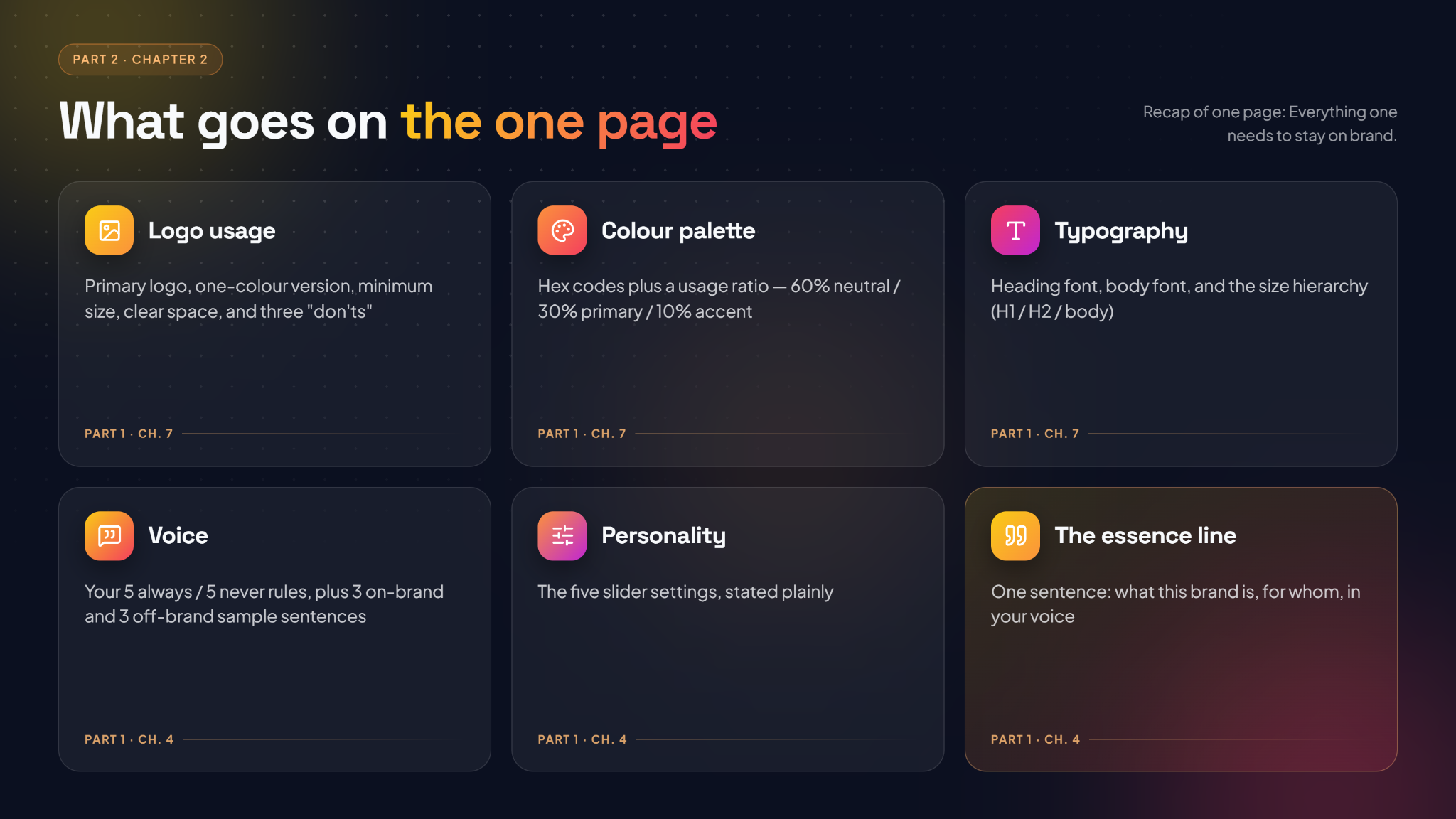
The off-brand examples are the secret weapon. "We never say things like: 'Unlock seamless solutions for your journey!'" teaches future-you (and any AI tool) faster than ten pages of theory.
Drafting it with AI
"Here is my Brand Brief: [paste]. Draft a one-page brand guidelines document with these sections: [table above]. Preserve my Human Notes exactly — do not 'improve' my voice rules or reword my essence line. For the voice section, write 3 sample sentences that follow my rules and 3 that break them, labeled."
Any of the major LLMs handles this well — it's structured language work, their home turf. The differences from Part 1 still apply (Claude for nuanced voice work, ChatGPT for fast iteration, Gemini if your files live in Google Workspace), but honestly: for this task, use whichever you're already in.
Where the guidelines live
Canva Brand Kit (free tier: 1 kit) — best if Canva will be your content factory in Chapter 7; colors, fonts, and logos auto-apply to everything you make.
Figma — best if you want more design control and multiple team members; steeper learning curve.
A plain PDF/doc — completely fine. The guidelines' value is in existing, not in the software that hosts them.
Your Chapter 2 output
A one-page guidelines doc, saved where you'll actually see it — plus your palette and fonts loaded into whichever tool you'll build with next.
Chapter 3: Your Website - Choosing the Stack
This is the most consequential tool decision in the whole course, and the one where hype does the most damage. There is no universally "best" AI website tool — there are three genuinely different paths, and the right one depends on what your brand sells, your technical comfort, and your budget. This course is neutral; here's the honest map.
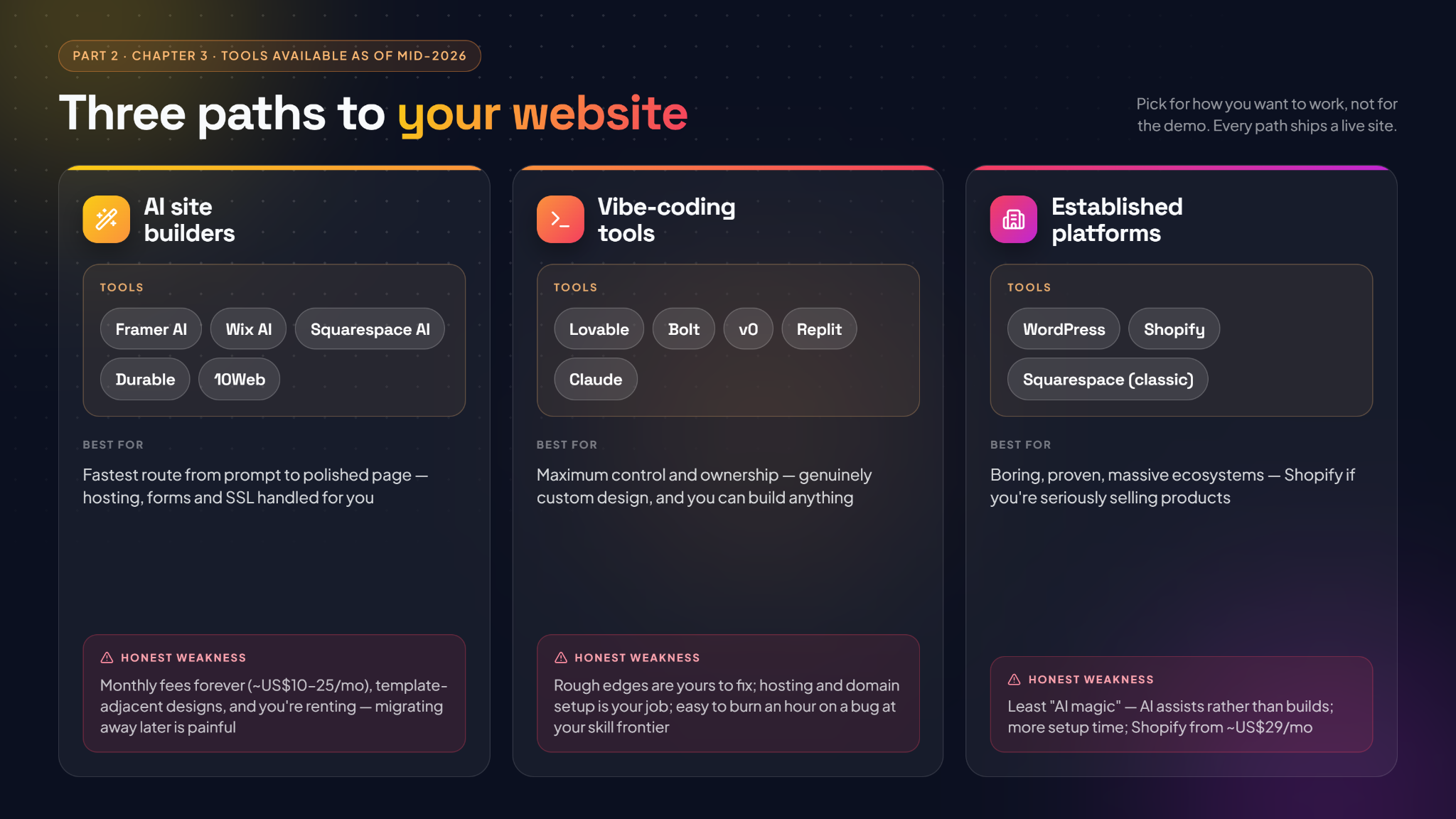
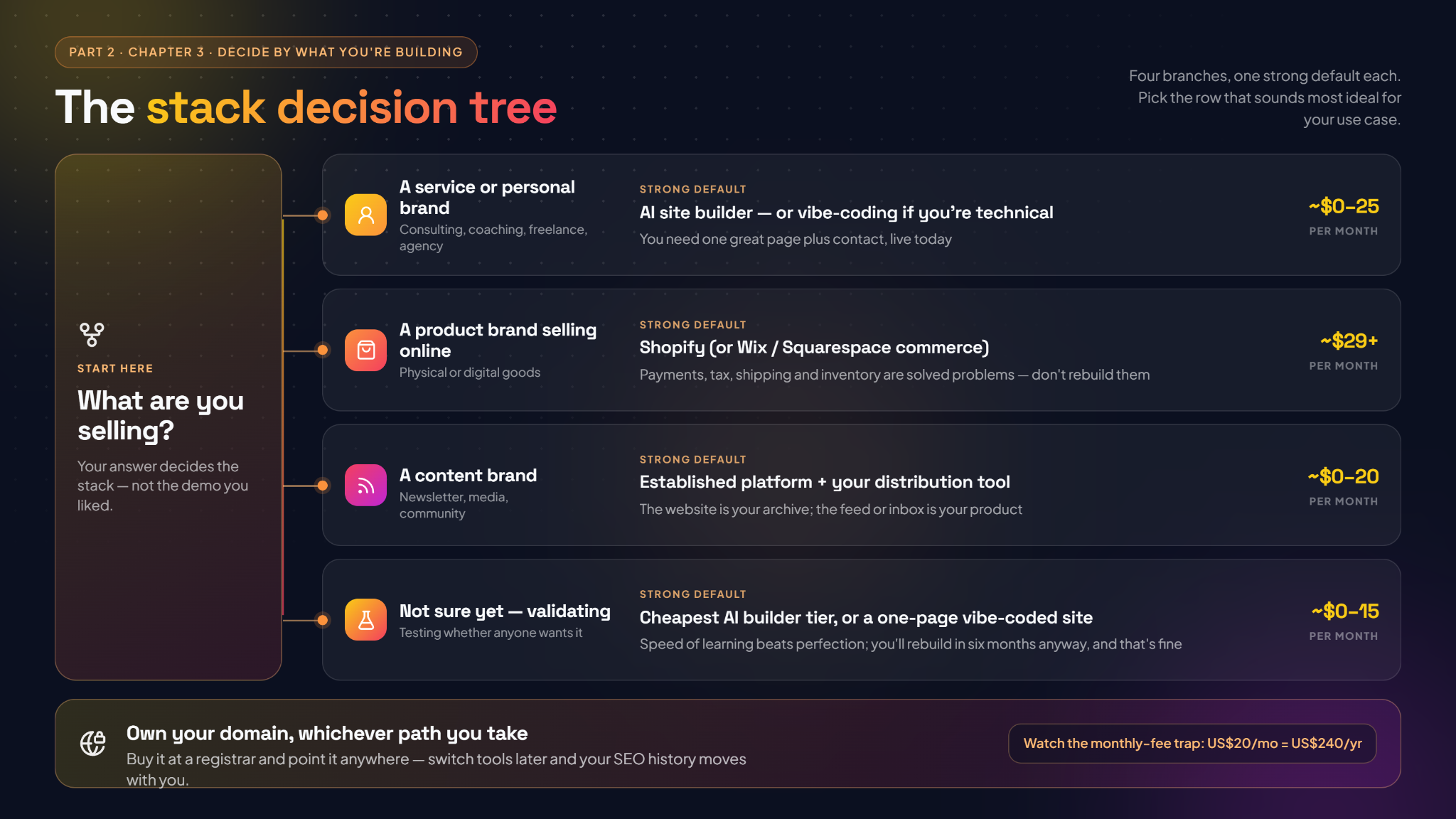
Two honest notes that most "build a site with AI" content skips:
The monthly-fee trap. AI builders demo free and bill monthly. US$20/mo is US$240/yr - real money for a validating idea. Check the price after the trial before you fall in love.
Own your domain regardless of path. Buy it at a registrar, point it at whatever you build. If you later switch tools (you likely will), your address - and your SEO history - moves with you.
Connect the domain
Every platform has a "connect custom domain" flow: it gives you 2–4 DNS records to paste into your registrar's dashboard. AI is genuinely useful here as a patient helpdesk: "I'm connecting a domain from [registrar] to [platform] — walk me through it step by step, and explain what each DNS record does in one line." Propagation can take minutes to a few hours; start it now and continue building.
Your Chapter 3 output
A chosen path, an account created, and your domain connection started.
Chapter 4: Your Website - Build & Copy
The longest block in Part 2, and deliberately so - your website is where positioning, voice, and visuals all have to hold hands in public for the first time. The good news: you are not starting from a blank page. You're starting from your brief.
One strong page beats five thin ones
Day-1 brands don't need a seven-page site. They need one page that converts a stranger into a believer, structured like this:
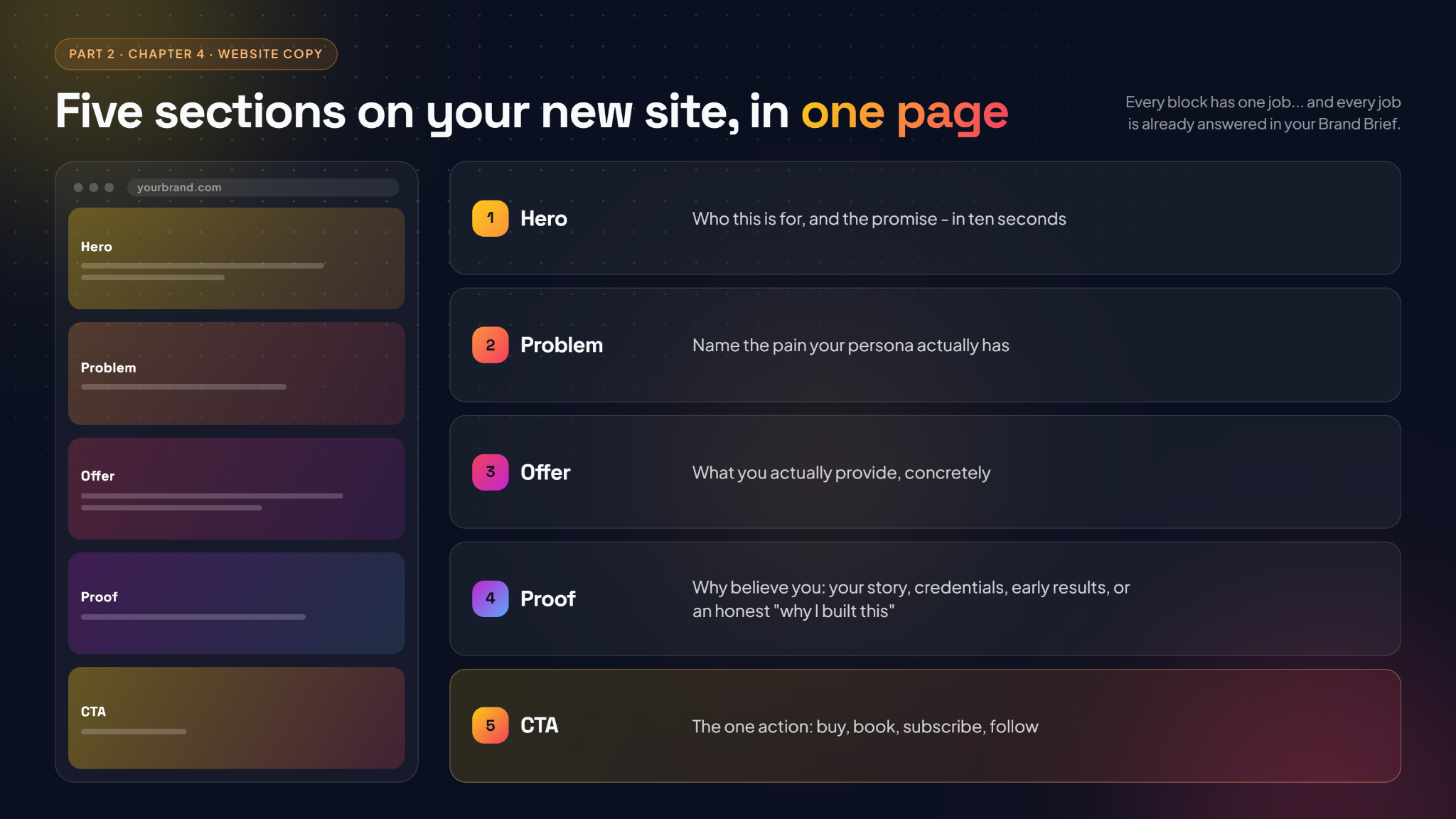
An About section, contact details, and legal footer round it out. Add more pages when reality demands them, not before.
Generating copy from the brief
The master prompt — works in any LLM or any AI builder's content step:
"Here is my Brand Brief: [paste]. Write website copy for a single-page site with these sections: hero, problem, offer, proof, CTA. Follow my voice rules strictly — especially the 'never' list. Preserve my Human Notes: [paste Section 10]. Keep the hero under 20 words. Write at the reading level my persona actually uses, not marketing-speak."
Then iterate section by section, not wholesale — "the hero is too clever, make it clearer" beats "try again." Two quality gates from Part 1 apply with full force:
The cliché ban. Add it to every prompt. Web copy is where "unlock seamless solutions" goes to breed.
The read-aloud test. Read the whole page out loud once. Anywhere you stumble or cringe is a sentence you didn't choose.
The 20-minute polish pass
Mobile first, literally: most of your visitors arrive on a phone. Check every section on yours; fix anything that requires pinching.
SEO minimums, no rabbit hole: a page title ("Brand Name — what you do, where"), a meta description (your positioning statement, lightly reworded), and readable headings. Ask AI: "Suggest a title tag and meta description from my positioning; 60 and 155 characters max." That's genuinely enough for launch day.
One image rule: every image either shows your actual work/product or was made from your brand palette. Random AI-generated "diverse team smiling at laptop" imagery is the visual equivalent of the naming sludge — instantly recognizable, quietly trust-eroding.
Speed: compress images before upload (builders often do this; vibe-coded sites won't).
Your Chapter 4 output
A live, on-brand, one-page website at your own domain — passing the phone test and the read-aloud test.
Chapter 5: Your Digital Groundwork
The unglamorous half hour that separates "a website exists" from "a real business is reachable." AI's role in this chapter is honest and small: it's a patient setup assistant, not a magician. Every item below is a checklist row, done once, valuable forever.
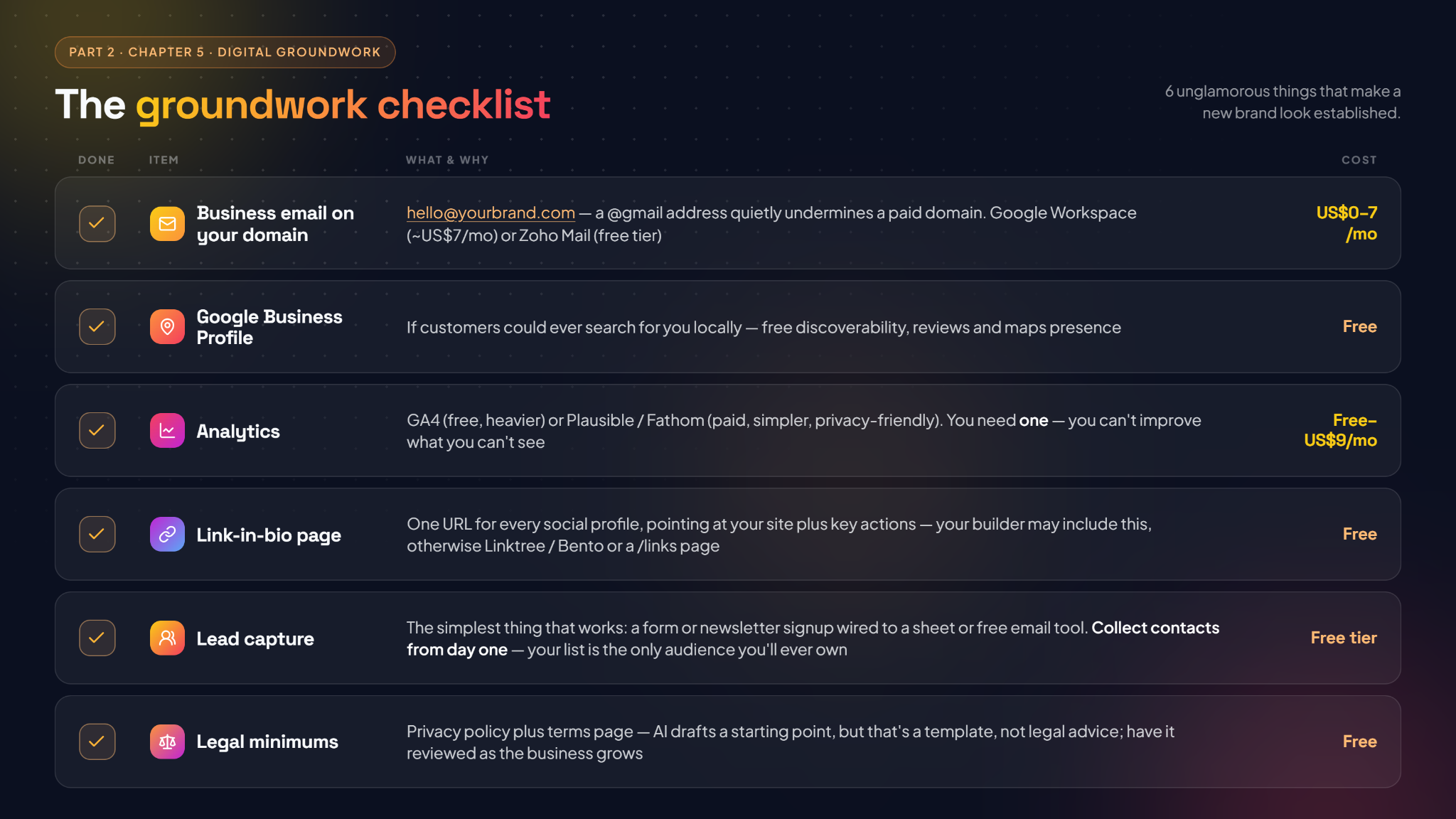
A worthwhile AI prompt for this chapter — the patient-helpdesk pattern again:
"I've just launched [type of brand] on [platform]. Walk me through setting up [item] step by step. I'm on [my registrar/tools]. One step at a time, wait for me to confirm each."
Your Chapter 5 output
Every row of the table checked or consciously deferred (deferring is fine; forgetting is not). You are now reachable, discoverable, measurable, and collecting contacts.
Chapter 6: Your Social Platforms
Here's the anti-overwhelm rule that makes this chapter 30 minutes instead of three hours: you are launching on one primary platform, plus one secondary. Not six. Every platform you add multiplies your content workload; every platform you neglect actively signals abandonment. Two done well beats six done half.
Choose by persona, not by hype
Go back to your Part 1 persona: where do they actually spend attention?
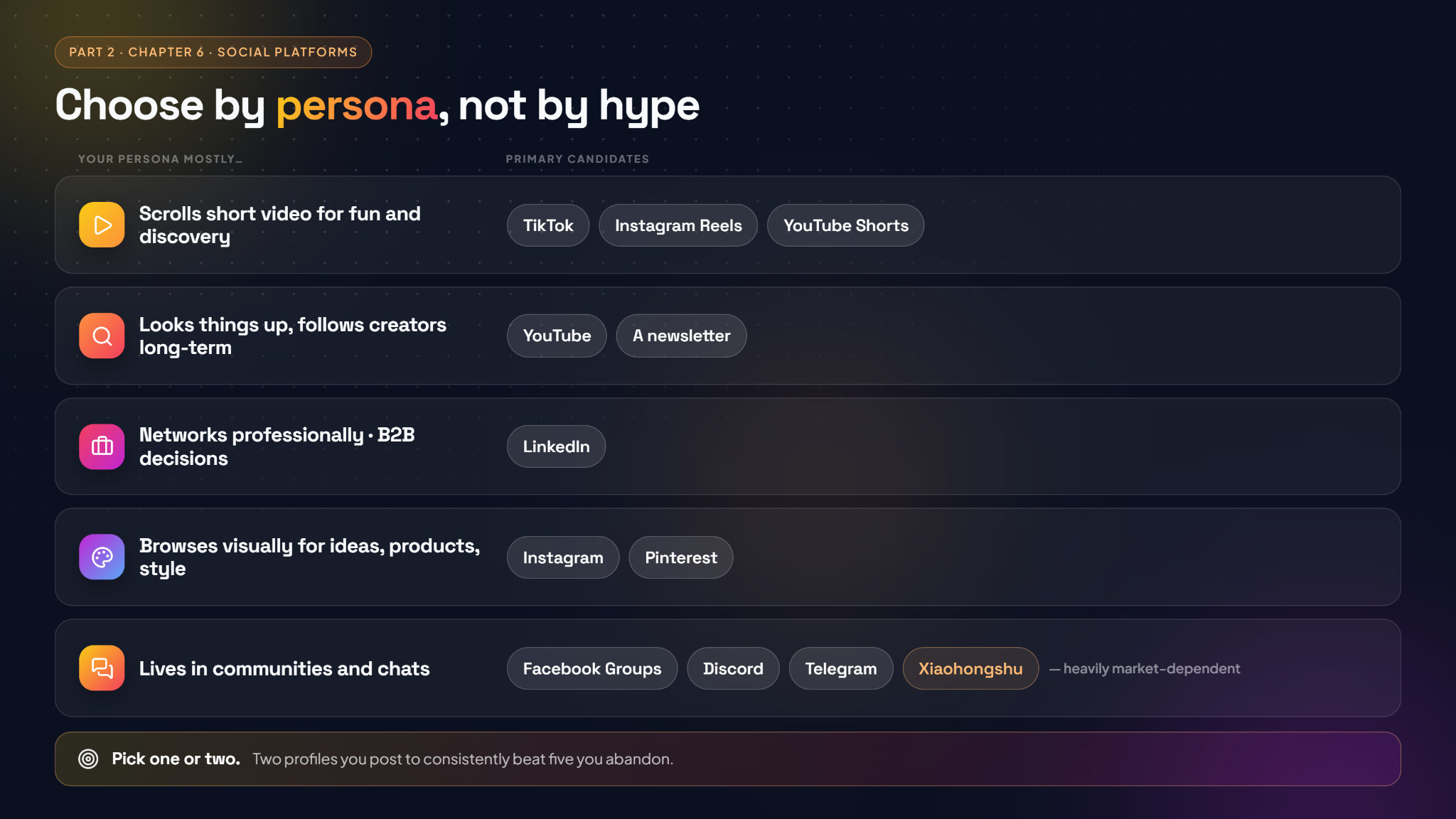
Ask AI to pressure-test, with your brief pasted: "Given this persona and offer, which ONE platform is my primary and which ONE secondary? Argue against the trendy answer if it doesn't fit my persona." (That last clause matters — left alone, most LLMs will simply recommend whatever's currently hot.)
Regional note: platform gravity varies hugely across Asia — what dominates in KL, Jakarta, Manila, and Shanghai are four different answers. Your persona's location is part of the decision, and this is a place where AI's suggestions need your local knowledge as the filter.
Set up with enforced consistency
Same handle everywhere (you verified this in Part 1, Chapter 6 — this is why). Same profile image treatment from your guidelines. Same link-in-bio URL. And a bio generated once, in your voice, then adapted per platform:
"From my Brand Brief, write my social bio: who I help, what I offer, one human detail from my Human Notes, and a CTA to my link. Then give me versions fitted to Instagram (150 chars), LinkedIn headline (220), and TikTok (80). Same voice in all three — do not get 'punchier' unless my voice rules say so."
Your Chapter 6 output
One primary + one secondary profile, live, consistent with your guidelines, linked to your site — and a conscious decision (written down!) about which platforms you are not on, and won't feel guilty about.
Chapter 7: Your First Content Batch
The brand exists; now it needs a heartbeat. This chapter produces two weeks of content in 45 minutes - honestly, which means confronting the uncomfortable truth first: AI-generated content sludge is now instantly recognizable, and feeds are drowning in it. Same hook structures, same emoji-studded listicles, same "Here's what nobody tells you 🧵" openers. Posting sludge doesn't grow a brand; it marks you as one of the thousand identical accounts your persona already scrolls past.

The Part 1 rule applies at double strength here: AI generates volume; your filter is the brand.
Three pillars, not seven
Derive your content pillars from positioning — three is enough:
Prove it: content that demonstrates your actual competence/product (the work itself, results, process)
Teach it: content that helps your persona with the problem you solve (generosity builds trust)
Be human: the why-I-built-this, behind-the-scenes, opinion content only you can make (this pillar is your Human Notes, serialized)
"From my Brand Brief, propose 3 content pillars using the prove/teach/human structure, then generate a 2-week calendar for [primary platform]: [your cadence, e.g., 4 posts/week], alternating pillars. For each post: hook, body outline, CTA — all following my voice rules. Mark which posts need a real photo/screen recording from me rather than generated imagery."
That last sentence is the honesty mechanism: the strongest content in your first two weeks will be the posts only you can supply - your actual product, face, screen, or story. Let AI structure them; don't let it fabricate them.
Batch, schedule, done
Visuals: build 2–3 reusable templates in Canva (with your Brand Kit from Chapter 2 auto-applied) rather than generating fresh AI imagery per post. Consistency compounds; novelty doesn't.
Scheduling: Buffer or Later (free tiers cover 1–2 platforms), Metricool (generous free tier, strong analytics), or your platform's native scheduler (free, fine for one platform). Schedule the fortnight in one sitting.
The 80/20 edit rule: AI drafts 80%; the 20% you rewrite — the hook in your actual phrasing, the detail only you know - is what makes it yours. A post you didn't edit is a post you didn't write.
Your Chapter 7 output
Three pillars, a two-week calendar, visuals templated, posts scheduled… with the human-input posts clearly flagged for you to complete.
Chapter 8: The Launch Filter
Stop again.
You know this checkpoint from Part 1 — and it matters even more now, because in twenty minutes, this stops being a project and starts being public. Everything you've built today was generated fast. Before it goes live, it faces the one reviewer AI can't simulate: you, acting as your customer.

Walk it as your persona
Phone in hand — not your laptop, and not the builder's preview mode. Open your site cold, the way a stranger arrives. Tap through to your profiles. Read your first scheduled post. Then answer the three launch questions, on paper, like before:
Would I trust this brand with my money? Not "is it pretty" — trust. Where does doubt creep in? That's your first fix.
Does this sound like a person or a template? Read the hero and your bio aloud. If any sentence could belong to a thousand other brands, it isn't yours yet.
What would embarrass me in six months? The placeholder you meant to replace, the claim you can't back, the AI image that looks almost right. Six-months-you already knows. Listen now.
The override pass, one last time
Fix at least three things on pure instinct before launch — a headline that's technically fine but not you, a stock-feeling image swapped for a real one, a CTA reworded the way you'd actually say it. This is the same curation muscle from Part 1, now applied to the thing the world will see.
Nothing launches unfiltered. That's the whole discipline, and by now it's yours.
Your Chapter 8 output
Three written answers, at least three instinct overrides made — and a build you're proud to push live.
Chapter 9: Launch + Day 2 & Onwards Plan
Time to Go Live.
Flip it all on: site published on your domain, profiles public, first post live now (not just scheduled - launch day deserves a real-time post), the rest of the fortnight queued. Then the announcement, in your voice:
"From my Brand Brief, draft my launch announcement for [platforms]: the honest story of why I built this (use my Human Notes), who it's for, and one clear CTA. No hype-speak — my 'never' list applies. Under 120 words."
Send it to the humans first - friends, colleagues, the group chats. Your first supporters aren't found by an algorithm; they already know you.
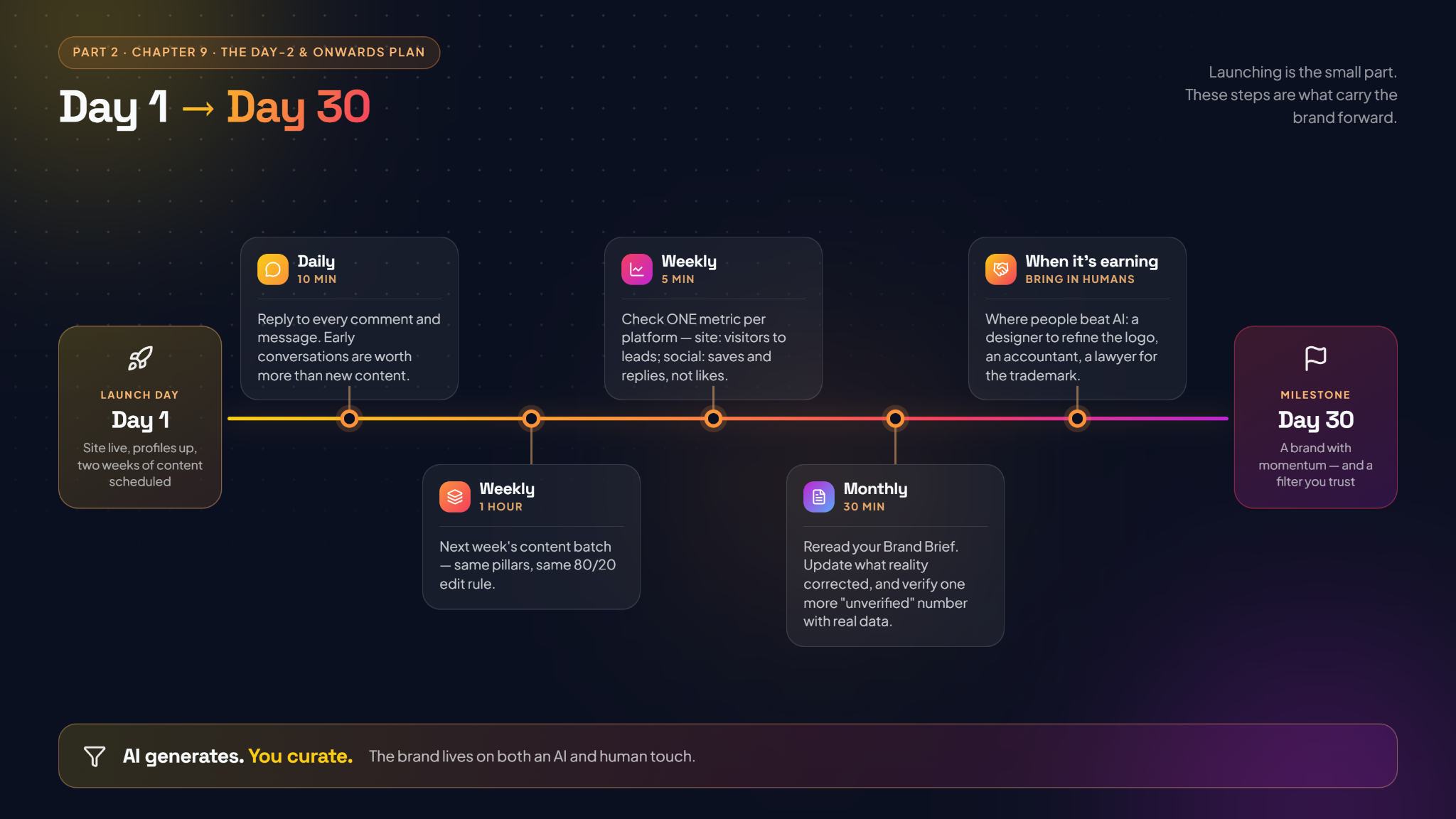
The part every one-day course skips: what happens beyond day 1.
A brand built in a day is real, but it isn't finished - it's started. The Day 2 & Onwards Plan is deliberately small, because the failure mode after a launch sprint isn't laziness, it's overcommitment followed by silence:
The end of the course, the start of the brand
Two courses ago, you had a rough idea. Now you have a positioned, named, visually coherent brand with a live website, active profiles, a content engine, and - most importantly - a working filter between what AI can generate and what deserves to carry your name.
That filter was never about this one day. Every future post, page, and product decision goes through it. AI generates. You curate. The brand is what survives your filter… now keep working better with AI, but retain your human touch.
Also remember: never stop learning.

Nice work — you've finished the reading
Ready to lock it in? Take the quick quiz and earn your free certificate.
Back to GMAsia Campus