
How to Build Your Brand in 1 Day with AI: Part 1
Go from rough idea to complete brand foundation — strategy, name, plan, and logo — in a single day with AI.
Built for small screens — bite-size cards and quick checks instead of long scrolling.
Try it interactiveIntroduction: The 1-Day Brand Sprint

Building a brand used to take weeks, sometimes months. Agencies would schedule discovery workshops, mood-board reviews, three rounds of logo revisions, and a final presentation with a five-figure invoice attached. For a solo founder or a small team, "branding" was either something you paid dearly for or something you skipped entirely and regretted later.
AI has collapsed that timeline. Not because AI does the thinking for you - it doesn't, and this course will be honest about that - but because AI removes the production bottleneck between having a thought and seeing it on screen. Want to test five brand personalities? That's now a 20-minute exercise, not a two-week agency cycle. Want to see your name in twelve logo directions? You can do it in less than an hour.
This course compresses the foundational work of branding into one focused day. Let’s say Part 1 is your morning: by lunch, you'll have a complete Brand Brief - your idea sharpened, your audience mapped, your positioning written, a lean business plan, a name that's actually available, and a working visual direction. Later on in part 2 of this course, we'll start work on turning that brief into brand guidelines, a live website, and active social channels.
Our tool philosophy: merit, not loyalty
You'll notice something unusual about this course: we don't champion one AI tool. Not ChatGPT, not Claude, not Gemini, not Midjourney. Every recommendation is made by task, on merit - including honest notes on where each tool is weak. The AI landscape shifts every few months, so treat our tool notes as accurate as of mid-2026 and always worth a quick sanity check.
The deeper reason for neutrality: the tool is never the differentiator. You are. Two founders using identical AI tools will build completely different brands, because the quality of a brand comes from the quality of the judgment applied to it. This course teaches you the judgment; the tools just make you fast.
The one rule of the sprint
AI accelerates. You decide. At every step of this morning, the AI will hand you options faster than you can evaluate them. Your job is not to accept: it's to choose. We'll return to this in force in Chapter 8, the Human Checkpoint, before you commit anything to your final brief.
Ch 2: Sharpening Your Idea
Most people open an AI chat and ask, "Is my business idea good?" The AI - trained to be helpful and agreeable - says yes, with caveats politely buried in paragraph four. You feel validated. You've learned nothing.
The fix is to change the AI's job. Don't hire it as a cheerleader. Hire it as a sparring partner.
Three prompt patterns that actually sharpen an idea
1. The Interrogation. Make the AI ask you questions before it's allowed to give opinions.
"I'm developing a business idea: [your one-sentence idea]. Before giving any opinion, interview me. Ask me one question at a time — up to 10 questions — about my customer, my motivation, my unfair advantage, and how this makes money. Push on vague answers."
Answering questions forces clarity that reading suggestions never will. Your idea usually improves before the AI has said anything substantive at all.
2. The Prosecution. Make the AI argue against you.
"Now argue that this idea will fail. Be specific and unsentimental: name the three most likely reasons, who beats me, and which of my assumptions is weakest. Do not soften the conclusion."
If the prosecution's case is strong and you have no answer, better to know at 9:30 AM on Day 1 than in month six.
3. The Ten Variations. Explore the space around your idea before committing to your first version of it.
"Give me 10 adjacent variations of this idea: shift the audience, the price point, the delivery model, or the niche. For each, one line on who it serves and why it might beat the original."
Often, some of the variations that come later, after multiple iterations, is the one worth building.
Which LLM for this chapter?
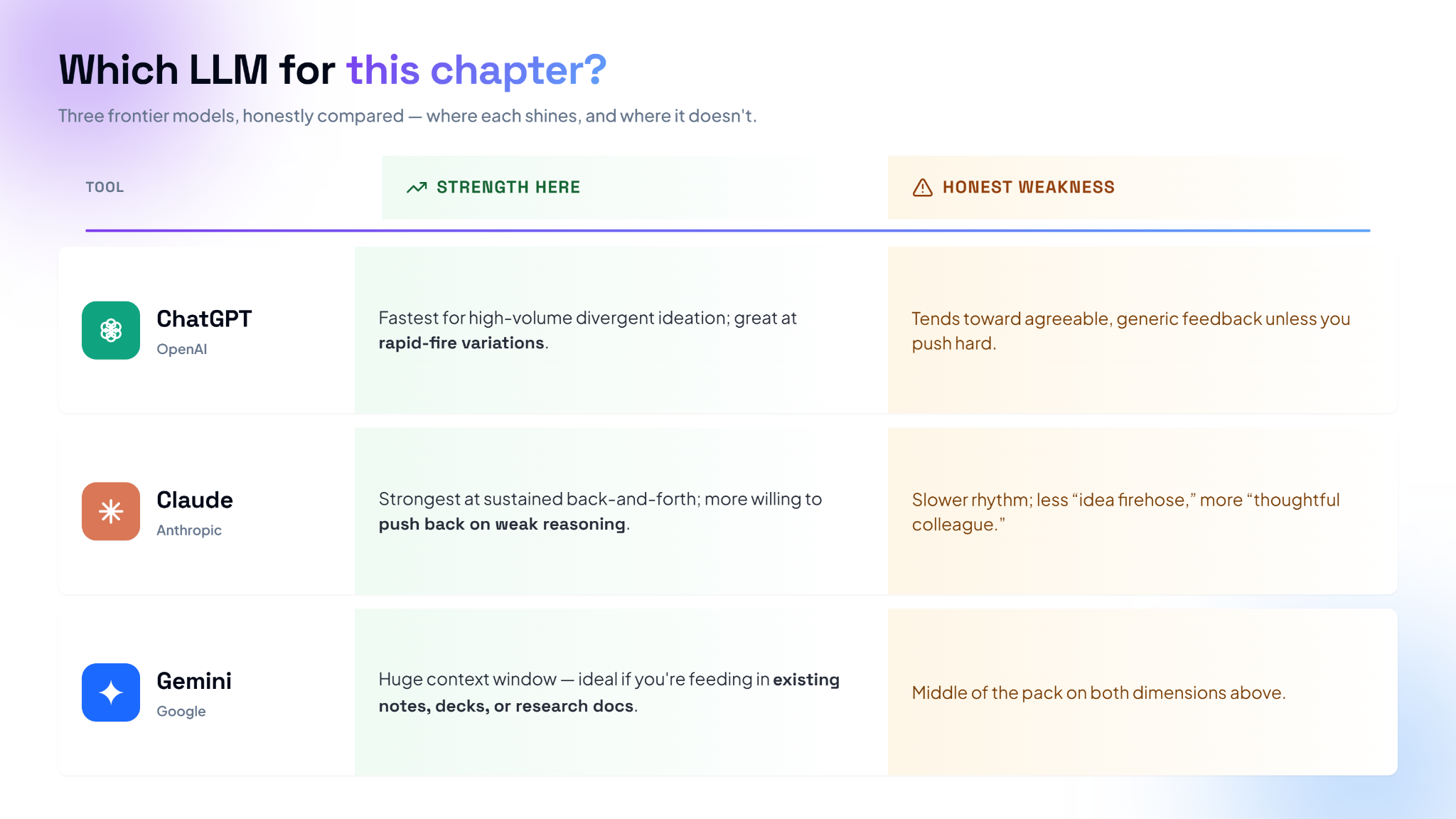
Any of the three will do the job. What matters far more than the tool is the adversarial framing — all LLMs default to validating you, because agreeable answers are what most users reward. The prompts above are the antidote.
Your Chapter 2 output
One paragraph, written by you (not pasted from the AI): your concept statement. Who it's for, what it does, why it will win, and the one risk you're consciously accepting. Save it… it's the first entry in your Brand Brief.
Ch 3: Fast Market & Audience Research
You now have a sharpened idea. The next question: who is actually going to care, and who's already serving them? Pre-AI, this meant days of Googling, skimming reports, and stalking competitor websites. You'll do a credible first pass in 45 minutes - if you use the right category of tool.
Use search-grounded AI, not a bare LLM
This is the chapter where tool choice genuinely changes your results. A plain LLM answering from memory will confidently hand you outdated market data and hallucinated statistics — figures that look precise and are simply invented. For research, you need AI that searches the live web and shows its sources:
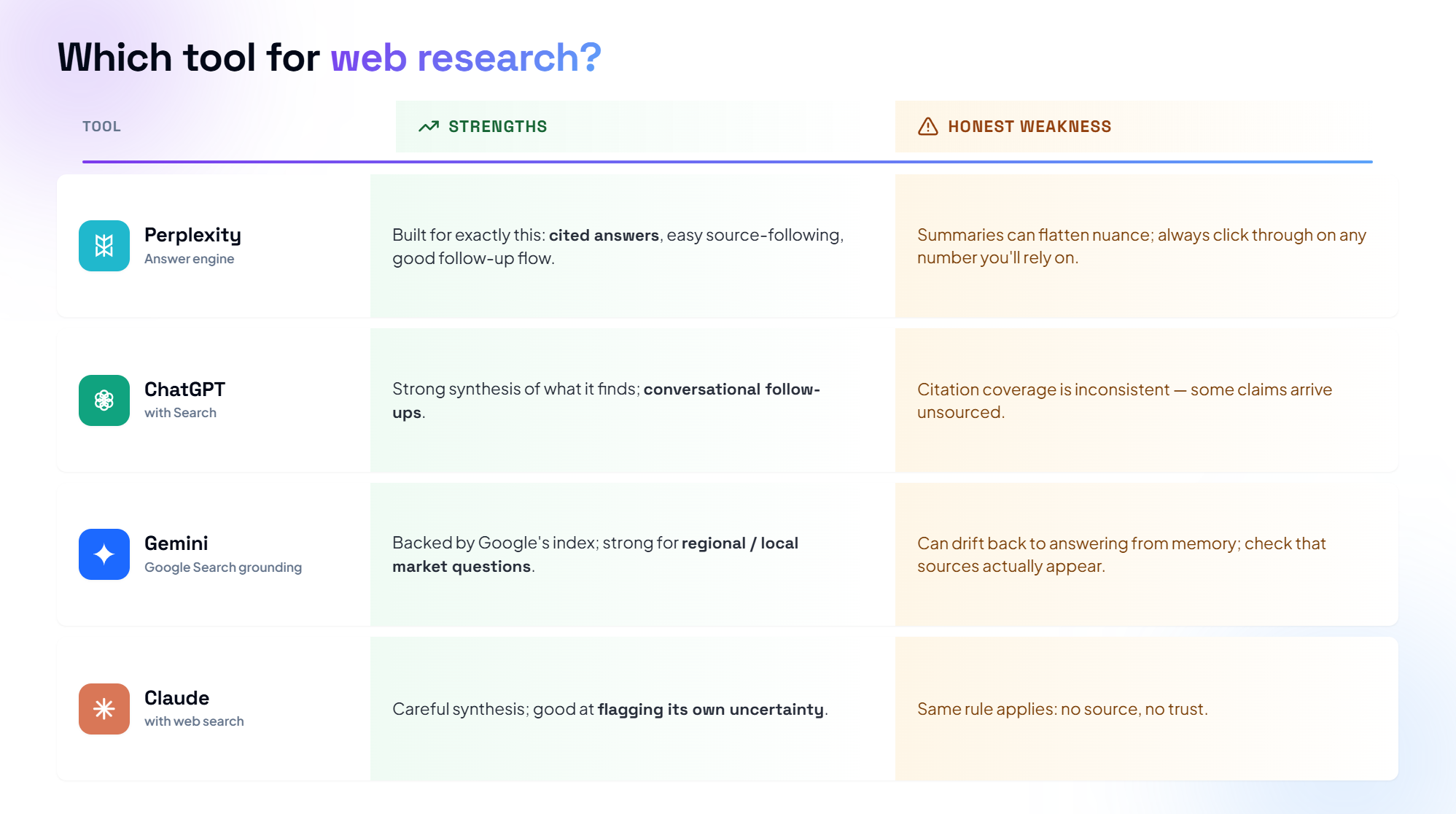
The iron rule of AI research: any statistic you plan to repeat, you click through and verify. AI is your research assistant, not your source. Cite the source, never "the AI said."
Sprint 1 — Competitor scan (20 min)
"Search for the main competitors to [your concept] serving [your market/region]. For the top 5–7: what they offer, their pricing, their positioning in one line, and what customers complain about in reviews. Cite sources."
The complaints are gold. Competitor weaknesses are the raw material of your positioning in Chapter 4.
Sprint 2 — Audience persona (15 min)
Feed your concept statement plus competitor findings into your LLM:
"Based on this concept and competitive landscape, draft 2 distinct customer personas. For each: who they are, what they're currently doing instead of using my product, what frustrates them about that, and what would make them switch. Mark clearly which parts are reasonable inference and which are assumptions I must validate with real people."
That last sentence matters. AI-generated personas are hypotheses, not facts — they're pattern-matched from similar markets. They're a great starting map; they are not a substitute for ever talking to a real customer.
Sprint 3 — The gap (10 min)
"Given these competitors and personas: where is the underserved gap? What position could a new entrant own that incumbents would find hard to copy?"
Your Chapter 3 output:
Three artifacts for your Brand Brief: a competitor table (5–7 rows: name, offer, price, positioning, weakness), your primary persona, and a one-line statement of the gap you intend to own.
Ch 4: Your Brand Strategy: Positioning, Personality, Voice
This is the heart of the morning. Everything before this chapter was input; everything after it is expression. Strategy is where you decide what your brand means — and it happens to be the work LLMs are genuinely best at, regardless of vendor, because it's pure language work: compressing fuzzy intentions into precise words.
The three layers you're building
Positioning — the one sentence that locates you in the customer's mind.
Personality — the human character your brand would have if it walked into a room.
Voice — how that character actually talks.
The Master Brand Strategist prompt
Paste this once, with your Chapters 2–3 outputs attached, and work through the layers in a single conversation so the AI holds full context:
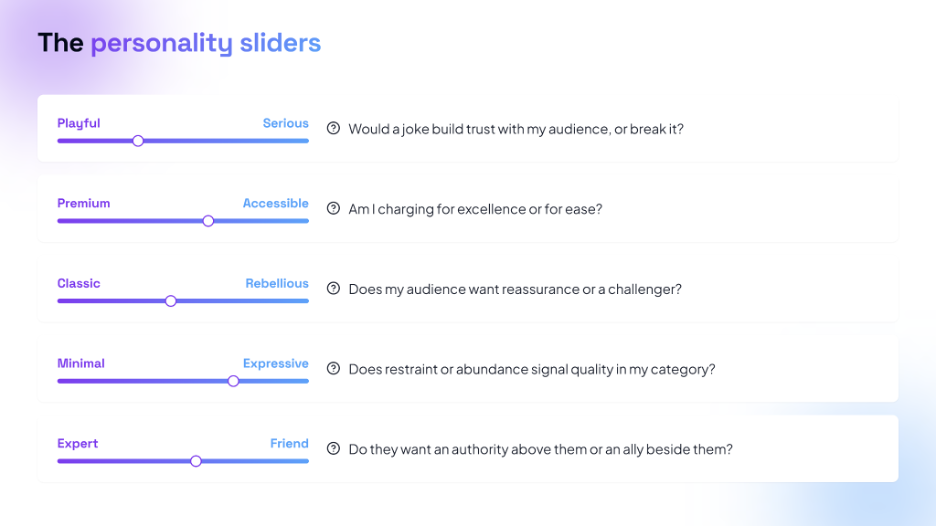
"You are a senior brand strategist. Here is my concept statement, competitor table, persona, and market gap: [paste]. Work with me through three steps, one at a time, waiting for my feedback after each: 1. Draft 5 positioning statements in the format: 'For [audience] who [need], [brand] is the [category] that [key benefit], unlike [alternative] which [limitation].' Make them meaningfully different, not rewordings. 2. Once I choose one, propose a brand personality using these sliders — Playful↔Serious, Premium↔Accessible, Classic↔Rebellious, Minimal↔Expressive, Expert↔Friend — with a one-line justification per slider tied to my audience and gap. 3. Then define the voice: 5 'we always' rules, 5 'we never' rules, and rewrite this sample sentence in the voice: [paste any plain sentence about your product]. Challenge my choices if they conflict with my positioning."
The personality sliders
Which LLM for this chapter?
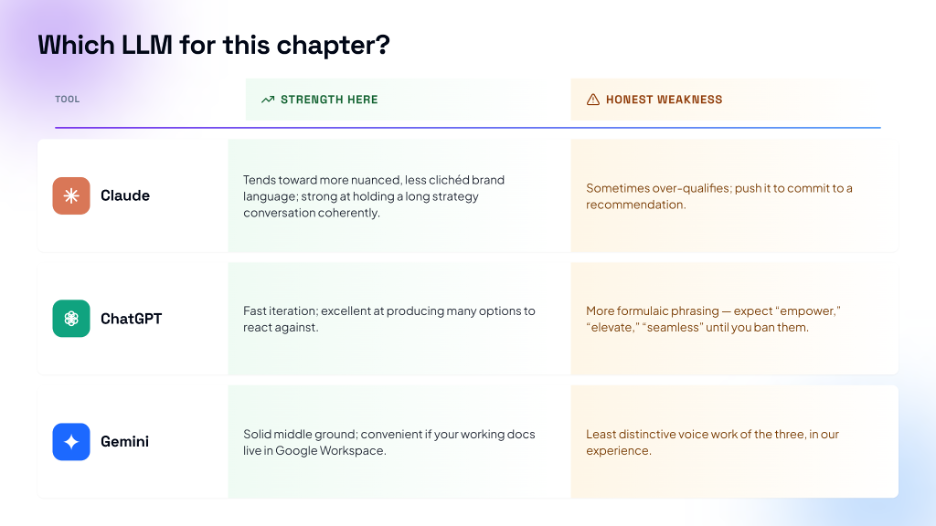
A trick that works on all three: ban the clichés explicitly. Add "Do not use the words: empower, elevate, unlock, seamless, journey, passion, solutions" to your prompt and watch the writing improve instantly.
Your Chapter 4 output
Your chosen positioning statement, your five slider settings, and your voice rules.
These three items will drive your name, your visuals, and your entire website and social presence in Part 2.
Ch 5: The Lean Business Plan
Nobody needs a 40-page business plan on Day 1 - least of all you. Banks don't read them; investors skim them; founders write them once and never open them again. What you need is a one-page lean canvas: the nine boxes that force you to confront how this brand actually survives.
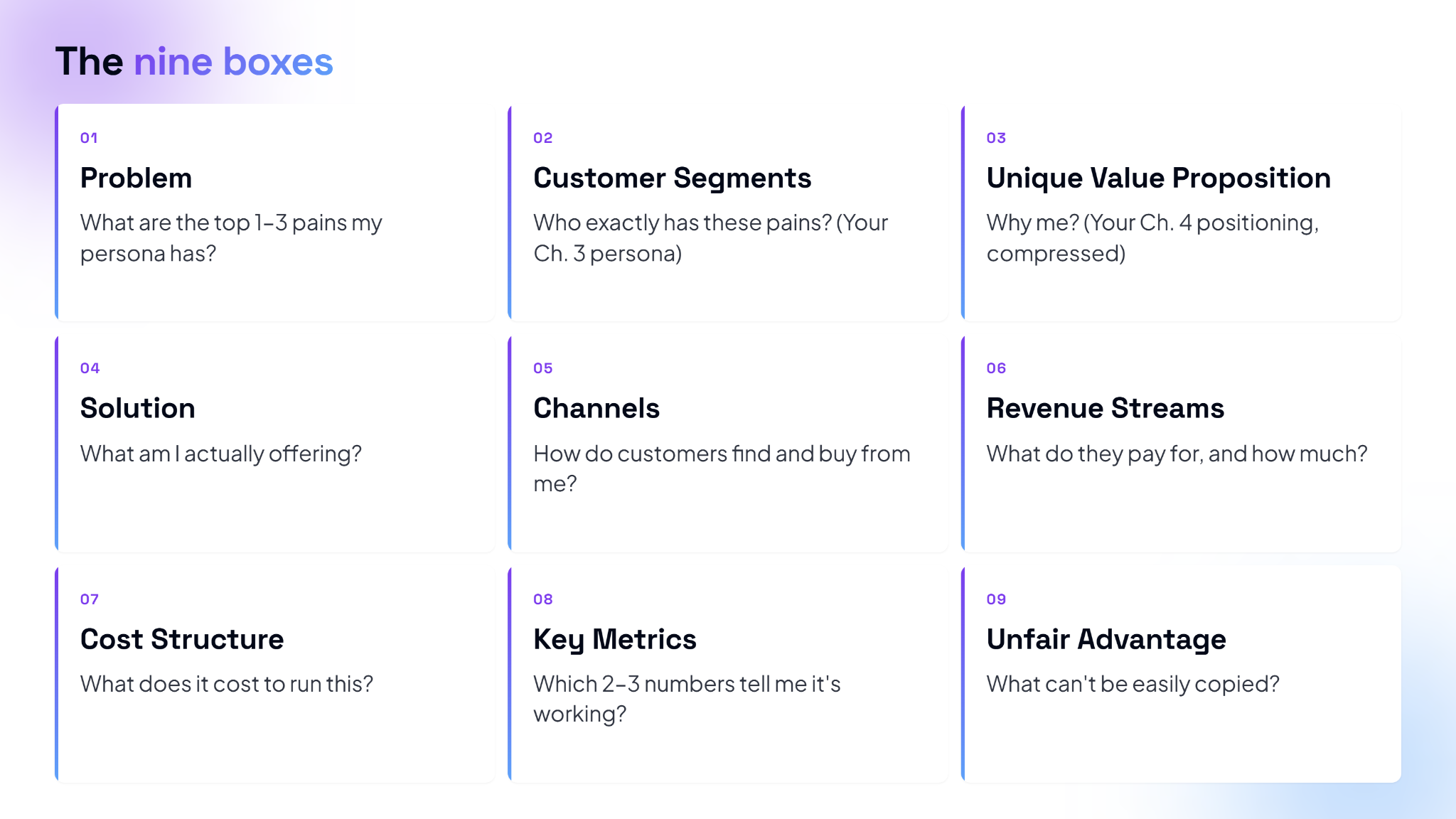
Let the AI draft it, then attack the numbers
You've already generated everything the canvas needs. So:
"Using my concept statement, personas, competitor table, and positioning [paste], draft a lean canvas with all nine boxes. Where you must estimate numbers (pricing, costs, market size), state the estimate AND label it '[UNVERIFIED — CHECK]'. List every assumption you made."
The honest warning, in bold because it matters: LLMs are unreliable at market sizing and unit economics. They will produce plausible-sounding revenue projections and "the market is worth $X billion" claims with total confidence and no basis. Every number on your canvas is a placeholder until you verify it — against real competitor prices (which you found in Chapter 3), real supplier quotes, and real platform fees. The canvas structure is AI-friendly; the numbers are your homework.
A genuinely useful follow-up prompt:
"Now act as a skeptical investor reading this canvas. Which box is weakest? Which number would you challenge first?"
Your Chapter 5 output
A completed one-page lean canvas, with unverified numbers clearly flagged. Done is better than perfect… you'll revise this monthly as reality reports in.
Ch 6: Next up: Naming Your Brand!

Naming feels like the fun part until you're 40 minutes deep in a chat thread full of names like "Brandly," "Nexify," and "Innovara." Here's the uncomfortable truth: left unconstrained, every LLM produces the same generic startup-name sludge — the "-ly / -ify / -ora" suffix soup — because it's pattern-matching thousands of existing startup names. The fix is constraint-heavy prompting.
The divergent sprint: 50 names, four lanes
"Generate 50 name candidates for [concept], with personality [your sliders] and positioning [paste]. Split them into four lanes: — 12 DESCRIPTIVE (say what it is: e.g. a name built from the product + a plain word) — 13 INVENTED (coined words that are pronounceable in English AND [your market's language]; NO names ending in -ly, -ify, -ora, -io) — 13 METAPHORICAL (drawn from nature, mythology, craft, or [a field adjacent to your brand's feeling]) — 12 UNEXPECTED (real words borrowed from an unrelated domain that capture the brand feeling) For each: one line on the association it triggers. No explanations of why naming matters. Just the names."
Two constraints in there deserve special mention for an Asian market: check pronounceability across your audience's languages, and ask the AI directly — "flag any of these names that have negative or comic meanings in Malay, Mandarin, Cantonese, Tamil, Thai, or Bahasa Indonesia." LLMs are genuinely useful for this first-pass cultural screen (though a native-speaker check before you commit is still wise).
The convergence: from 50 to 3
Shortlist 8–10 that pass your gut test. Then score them:
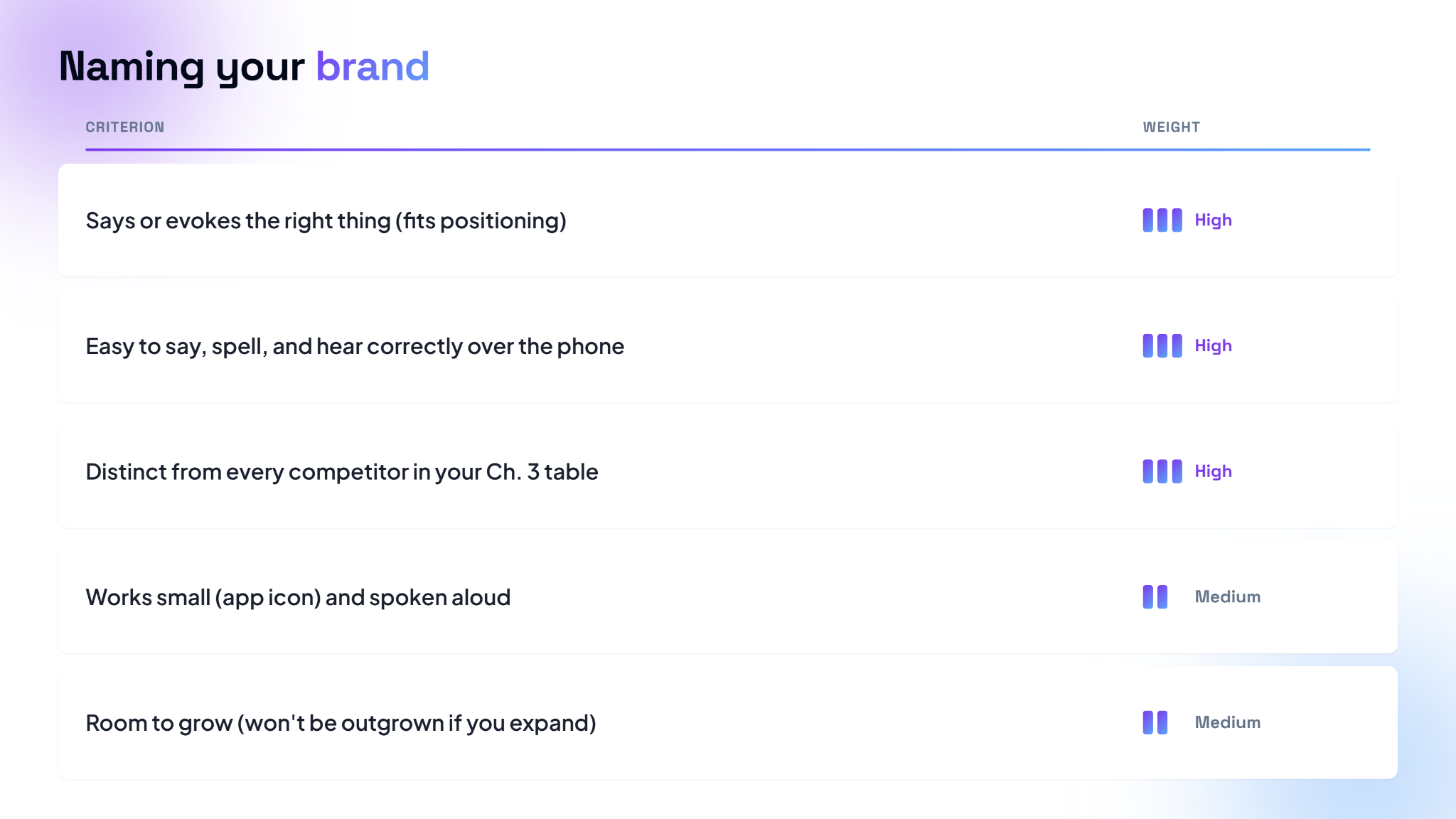
The part AI cannot do: availability
This is a hard loop between AI and the real world, and it's non-negotiable:
Domain — check your top names on a registrar (Namecheap, GoDaddy, or similar). The .com may be gone; decide honestly whether .co / .ai / .my / .asia serves you.
Social handles — check Instagram, TikTok, LinkedIn, X, and any platform that matters to your persona. Consistency beats cleverness: @brandname everywhere is worth fighting for.
Trademark — run a basic search on your national IP office database (MyIPO in Malaysia, IPOS in Singapore, etc.) and a general web search for conflicts in your category. This is a first-pass screen, not legal advice — if the brand is a serious venture, a one-hour consult with an IP professional later is cheap insurance.
Then loop the results back into the AI: "[Name] is taken. Give me 10 variations that preserve its feeling but are more ownable." This generate → check → regenerate loop usually lands a real, available name within two or three rounds.
Your Chapter 6 output
One name, with its domain available (or purchased, if you're feeling committed: ~US$10–15), handles confirmed, and no obvious trademark conflict.
Ch 7: Your Logo & Visual Direction
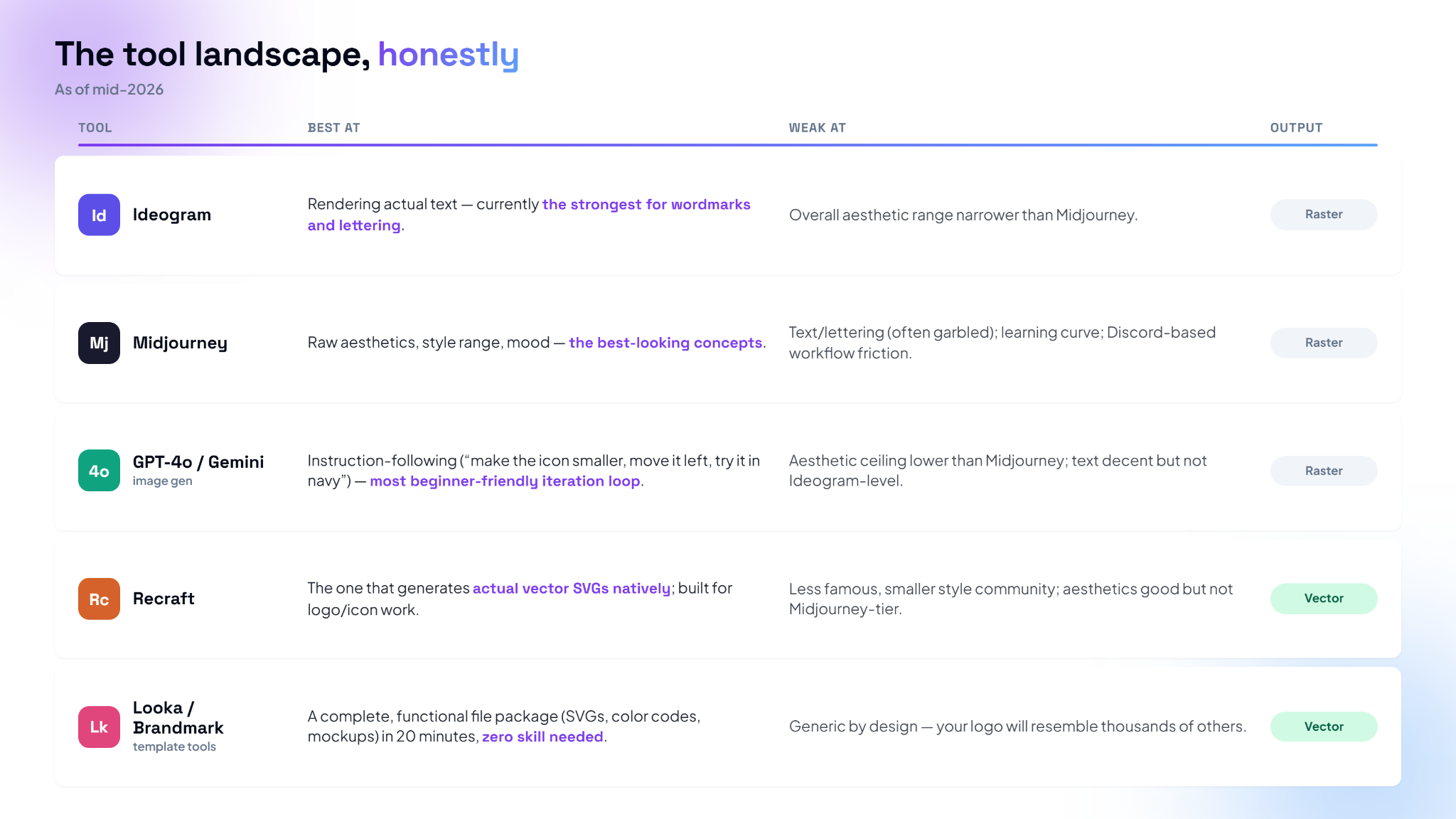
This is the most tool-differentiated chapter in the course: the one where "just use any AI" is genuinely bad advice - and it's also where most AI branding tutorials quietly mislead you. So let's be precise about what each tool is good at, and honest about the trap almost everyone falls into.
First, the trap: pixels are not a logo
Image generators output raster images — grids of pixels (PNG/JPG). A real, usable logo needs to be a vector file (SVG/EPS/PDF) — a mathematical shape that scales from a favicon to a billboard without blurring, recolors in one click, and is what every printer, signmaker, and merch supplier will ask you for.
A beautiful Midjourney logo PNG is a concept, not a deliverable. Plan for the vectorization step from the start — it changes which tool you should pick.
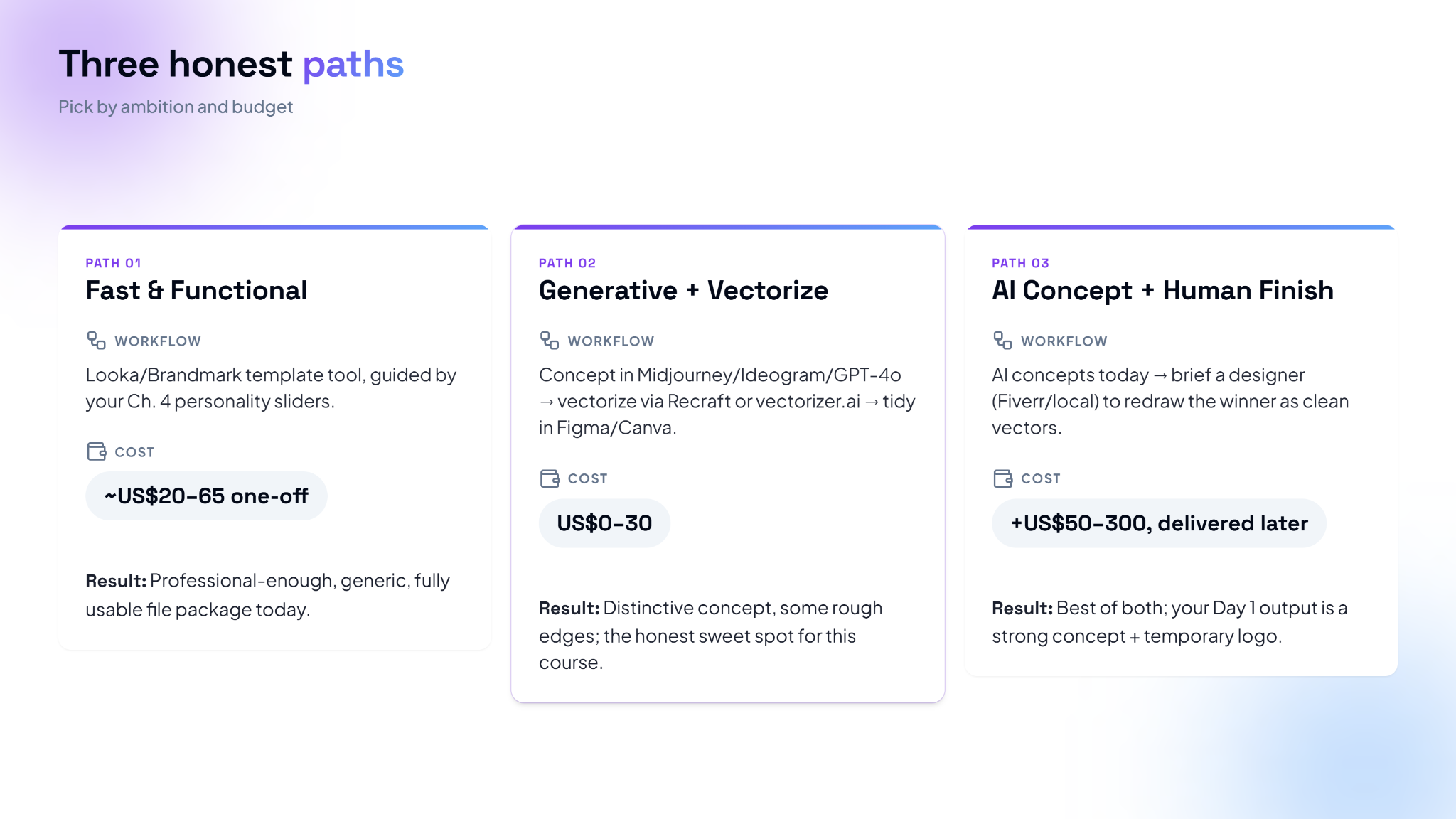
There is no shame in Path 1 and no requirement for Path 3. Path 2 is what we'll assume for the rest of the chapter.
Prompting your logo (Path 2 workflow)
Translate your Chapter 4 sliders into visual language first — with an LLM's help:
"My brand personality is [sliders + positioning]. Translate this into visual direction: 3 adjectives for the logo's feeling, suitable logo styles (wordmark / lettermark / abstract icon / mascot / emblem), and what to avoid."
Then generate, iterating in batches:
"Minimalist [style] logo for a [category] brand called [Name], [3 adjectives], flat vector style, solid white background, no photorealism, no gradients, single color."
Practical tips that save an hour: generate in one color first (a logo that only works in full color is a fragile logo); ask for "flat vector style" even in raster tools (it makes vectorization dramatically cleaner); and expect to run 20–40 generations before something clicks. That's normal, not failure.
Color palette
Feed your personality into any LLM: "Given [sliders/positioning], propose 3 palette directions: primary, secondary, one accent, plus neutral tones — with hex codes and a one-line rationale each. Consider color associations in [your market]." Then pressure-test the winner at coolors.co (contrast, colorblind view). Cultural note for Asian markets: color symbolism varies enormously (white, red, and gold carry very different weights across the region) — ask the AI explicitly about your specific audience.
Typography
Two fonts are enough: one for headings, one for body. Ask your LLM for "5 Google Fonts pairings matching [personality], with rationale" — Google Fonts keeps you free and license-safe — or use Fontjoy to generate pairings visually. Rule of thumb: one font with character, one workhorse.
Your Chapter 7 output
A logo concept (ideally vectorized), a palette with hex codes, and two fonts. Not final art - a working visual direction that Part 2 will refine into full brand guidelines.
Ch 8: The Human Checkpoint
Stop.
You've spent four hours generating. Ideas, personas, positioning statements, fifty names, forty logo drafts. Everything came fast, and most of it looked pretty good. This chapter exists because of a trap hiding inside that speed - and because the next thing you do is commit choices to your Brand Brief, permanently.
The trap of frictionless generation
When producing an option costs thirty seconds, evaluating it starts to feel like the expensive part — so you stop doing it properly. You accept things because they're there, and they're fine, and the next prompt is already waiting. Friction used to be built into brand work: sleeping on a name, sketching a logo by hand, defending a tagline to a colleague. That friction wasn't waste. It was where judgment happened. AI removed the friction; it's your job to put the judgment back deliberately.

"Can" is not "should"
Here's what an LLM is actually doing when it writes your positioning or names your company: pattern-matching what brands like yours usually sound like. That's precisely how you end up average. The AI has read a million brand strategies; it will hand you the statistical center of them. Your weird preferences, your backstory, the customer conversation you had last year, your taste — these are the only inputs the AI doesn't have unless you insist on them. In a market about to be flooded with AI-generated brands, the statistical center is the most crowded place to stand.
And your customers can increasingly feel the difference. People want to know a brand was curated by someone real — that a human chose this name for a reason, that the colors mean something. The detectable human fingerprint is becoming a competitive asset, not a nicety. Your taste is the moat.
The 10-minute analog exercise
Screens off - actually off. Take the paper and pen, and answer three questions:
What do I want this brand to feel like that no AI suggested? (There's usually something. Write it down before it evaporates.)
What did I accept today just because it was there? (Be honest. There's at least one.)
If I had to rebuild the brand from memory right now, what would I keep? — What you remember without looking is what actually resonated. What you can't remember was never yours.
The override pass
Go back through the morning's outputs and change at least three things purely on instinct — even if the AI's version scored "better." Swap a color because the AI's choice feels corporate. Reword the positioning so it sounds like you'd actually say it aloud. Pick the slightly stranger name. This isn't decoration; it's the curation muscle that every future brand decision — every post, every product page in Part 2 — will depend on.
The rule going forward
AI generates. You curate. The brand is what survives your filter. Only what passes this checkpoint goes into your Brand Brief.
Ch 9: Finally: Assembling Your Brand Brief
The capstone: compress everything that survived your human filter into one document. The Brand Brief is the operating input for Part 2 - when Part 2 is live, you'll paste it into AI tools to generate guidelines, website copy, and social content — and it's your consistency engine for every brand decision after that.
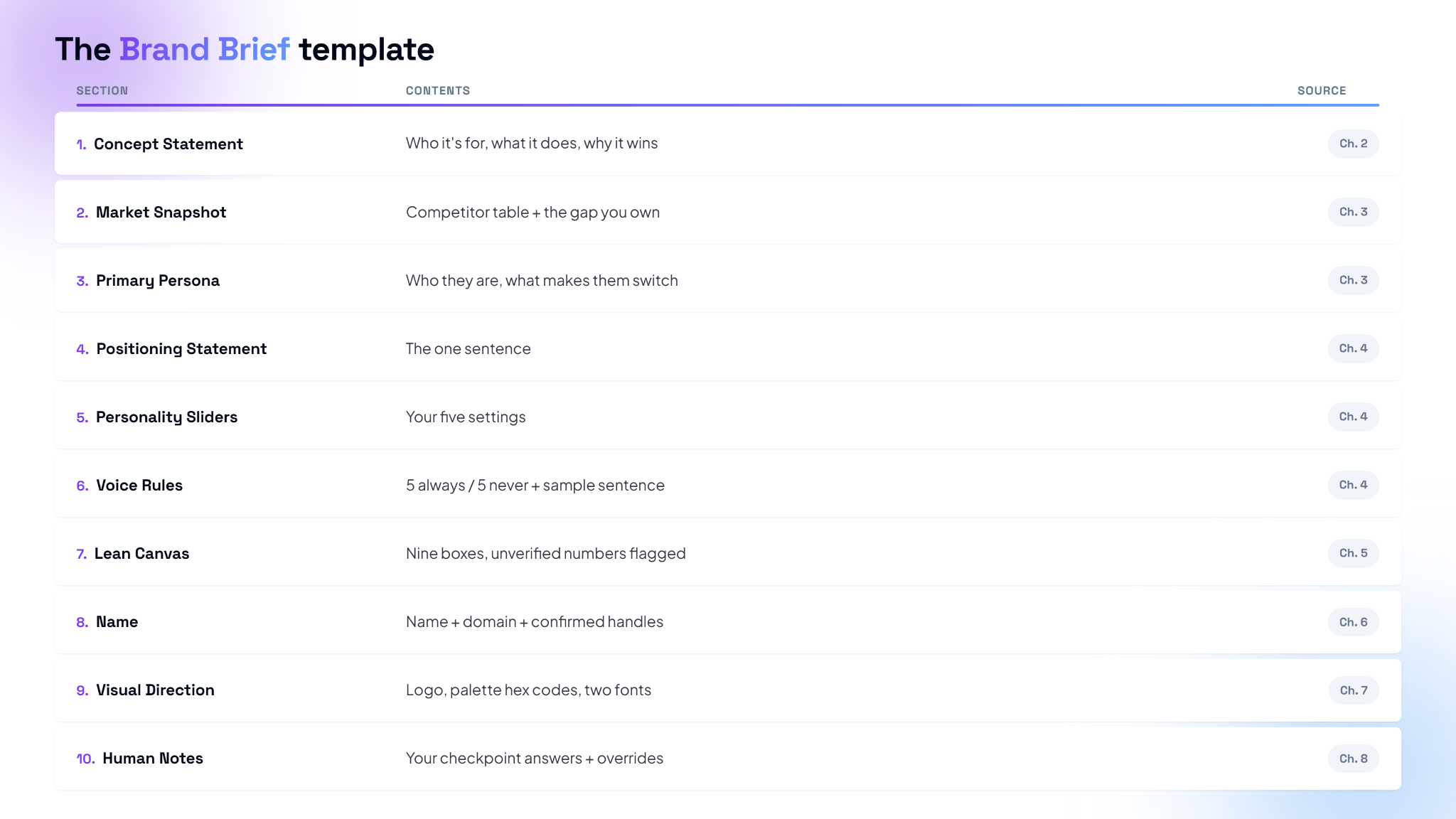
Section 10 is not optional - in Part 2 you'll tell the AI to preserve those human notes, so your brand never regresses to the AI mean.
Assemble, then read aloud
Have your LLM compile it: "Compile these into a Brand Brief using this 10-section structure. Compress and organize only — add nothing." Then the final check no AI can do: read the whole brief aloud once. Anywhere you stumble is a line you didn't truly choose. Fix it.
That's Part 1 of our course done: a stress-tested concept, a strategy, a plan, a name you own, a visual direction, and a document carrying your judgment.
Stay tuned for part 2 coming next week, where you'll learn more about what happens when your brand goes live!

Nice work — you've finished the reading
Ready to lock it in? Take the quick quiz and earn your free certificate.
Back to GMAsia Campus