
Choosing the Right LLM (Large Language Model)
There's no single 'best' AI. Learn the six-point framework to pick the right model for the job — and how to read where each lab is headed next.
Built for small screens — bite-size cards and quick checks instead of long scrolling.
Try it interactiveThe myth: "just tell me the best one"

Everyone asks the same question: which AI is the best one?
Reality check: there isn't one. Ask it anyway, and you'll get a different answer every month — because the rankings actually do reshuffle every month.
The better question isn't "which is best." It's "best for what?" And that needs a real framework, not a gut feeling.
Six things worth checking, every time:
- Strength & common use case — what is it actually good at?
- Cost — free, flat subscription, or pay-per-use?
- Tone — does it sound the way you want to sound?
- Knowledge cutoff & live access — does it know this week, or just last year?
- Ease of access in Asia — can you actually reach it, without a workaround?
- General-purpose vs. narrow — is this a generalist, or built for one job?
Run any tool through these six, and "which is best" turns into an answer you can actually use.
The general-purpose lineup
Five labs currently define the general-purpose category. Not versions — labs. Version numbers change monthly; what each lab is for changes much more slowly.
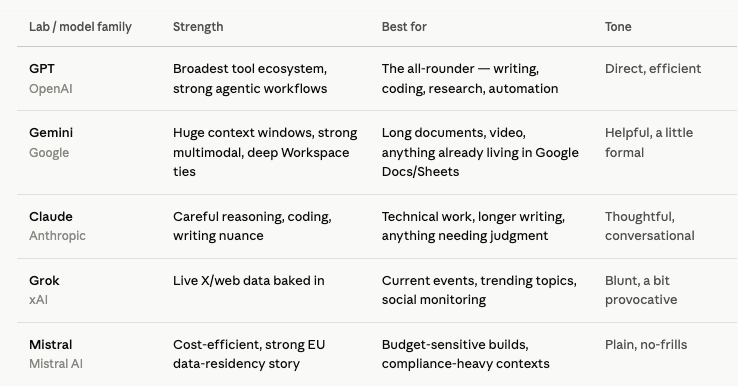
Not on this table on purpose: Perplexity and Poe. Neither trains its own frontier model — both are built on top of the labs above. They belong in the next section.
API vs. the app you already know
The app is enough for almost everyone. ChatGPT, Claude, Gemini — open the app, type, done. No setup, flat monthly cost, nothing to configure.
The API matters when you're building something. Automating a task, powering a tool, calling a model from your own code — that's when you reach for API access instead of a chat window. Pay-per-use, not flat fee. Usually not the first thing a beginner needs.
Aggregators sit in between. Two worth knowing:
- Poe — one subscription, many models from different labs in one place. Useful for comparing models side by side without five separate accounts. Downside: you lose the deep tool-integration each lab builds into its own app.
- Perplexity — built specifically for search-and-cite answers, not general conversation. It runs on top of other labs' models (or its own smaller one) rather than training its own frontier model. Reach for it when you want a sourced, current answer with citations — not as a replacement for a general assistant.
Developer-facing note: OpenRouter plays the same aggregator role Poe does, but for API access rather than chat.
The China question, handled straight
Here's the honest premise, stated plainly: US labs currently lead. China is closing the gap fast. Both halves of that sentence are true, and neither cancels the other out.
The real, defensible case for Chinese models isn't hype — it's arithmetic:
- DeepSeek — open-weight, frequently lands within a few points of frontier US models on coding, math, and reasoning benchmarks, at a fraction of the cost.
- Qwen (Alibaba) — massive open-weight model, strong multimodal and agentic capability.
- GLM (Zhipu / Z.ai) — mixture-of-experts architecture, tops several open-weight leaderboards outright, released under a permissive license.
Cheap, with matching performance on plenty of tasks. That's the actual claim, and it holds up on the numbers.
What it doesn't automatically settle: data residency (where does your input actually go?), content handling on politically sensitive topics, and the fact that "near-frontier" isn't "frontier" on the hardest reasoning tasks. Weigh those against your actual use case — bulk drafting and coding lean toward "the savings are real"; anything with sensitive company data or politically sensitive content deserves more caution.
The caveat that matters most: whatever ranks where today will have moved by the time you read this. Three major open-weight releases can reshuffle the leaderboard in a single quarter. Don't anchor to this week's number — anchor to the pattern.
Values over version numbers

Here's the pattern worth anchoring to: each lab's direction says more than this week's benchmark does.
- OpenAI — move fast, ship everywhere, widest tool ecosystem.
- Anthropic — safety-first framing, reasoning depth, careful writing.
- Google — ecosystem integration, multimodal scale, everything talks to everything else.
- xAI — speed, real-time data, a deliberately less filtered tone.
- Mistral — open efficiency, the compliance-friendly option.
- Chinese labs — cost-democratization as the explicit strategy, open weights as the delivery method.
Why this matters more than it sounds like it should: a lab's direction predicts its next moves — new skills, plugins, agent tools, integrations — long before any single release does. A lab chasing tool ecosystems will keep shipping plugins. A lab chasing safety will keep shipping guardrails and slower, more deliberate releases. A lab chasing cost will keep undercutting on price.
That's the thing to know before you build deep into one ecosystem. Wiring your workflow tightly into one lab's specific tools is a bigger commitment than picking a chat app for today — know the direction first.
What to try from here
Pick two or three — from different rows. One general-purpose favorite, one from a different lab entirely, maybe one Chinese open-weight model if cost is a real factor for you.
Run one real piece of your own work through each. Not a toy question — the email you were about to write, the code you were about to debug, the summary you needed today.
Keep whichever one you'd actually trust with that task again.
Does the exact model matter? For most everyday work — less than people think. The differences show up hardest at the edges: cost at real scale, live/current data, specific benchmark tasks, data residency. For a normal day's writing, drafting, or quick research, several of these tools would serve you equally well. The framework in this course isn't for finding a universal winner — it's for knowing which edge case you're actually optimizing for, and picking accordingly.
Nexa's Verdict: The category is genuinely mature and genuinely fast-moving at the same time. The framework outlasts any one model — that's what's actually worth remembering here.
What you now know
- There's no single "best" LLM — compare on strength, cost, tone, knowledge currency, access, and generalist-vs-narrow.
- GPT, Gemini, Claude, Grok, and Mistral each have a distinct strength — pick by task, not by brand loyalty.
- Test 2–3 tools against your own real work. Keep the one that earns your trust.
- Perplexity and Poe are app layers built on other labs' models, not new foundation models — use them for search-and-cite or side-by-side comparison, not as your main assistant.
- Chinese models (DeepSeek, Qwen, GLM) genuinely deliver near-frontier performance at a fraction of the cost — real tradeoffs apply, but the cost case is factual, not hype.
- Track each lab's direction, not just today's leaderboard — it tells you what's coming before the next release does.
Nice work — you've finished the reading
Ready to lock it in? Take the quick quiz and earn your free certificate.
Back to GMAsia Campus